
What Is a Portable Mortgage? Could It Work in the US?
- Published on
- 10 min read
-
 Richard Haddad Executive EditorClose
Richard Haddad Executive Editor
Richard Haddad Executive EditorClose
Richard Haddad Executive EditorRichard Haddad is the executive editor of HomeLight.com. He works with an experienced content team that oversees the company’s blog featuring in-depth articles about the home buying and selling process, homeownership news, home care and design tips, and related real estate trends. Previously, he served as an editor and content producer for World Company, Gannett, and Western News & Info, where he also served as news director and director of internet operations.
If you’ve locked in a mortgage rate in the 2%, 3%, or 4% range, the idea of moving can feel like financial foolishness. Selling your home means taking on today’s higher rates and larger monthly payments. Wouldn’t it be nice if you could carry your low pandemic-era rate over to your new home loan?
While portable mortgages aren’t currently available in the United States, they’re used in other countries and are now being discussed by U.S. housing officials as a possible way to ease the rate lock-in, or “golden handcuffs,” effect.
But what is a portable mortgage? How does it work? Who might it help? To explain the concept, we spoke with Steven Chester, a loan officer in San Antonio, Texas, with 24 years of experience in mortgage lending.

How Much Is Your Home Worth Now?
Home values have rapidly increased in recent years. How much is your current home worth now? Get a ballpark estimate from HomeLight’s free Home Value Estimator.
What is a portable mortgage?
“Portable mortgages basically allow you to take your existing mortgage debt on your current property, at that same rate, and carry it over to the next property,” Chester explains.
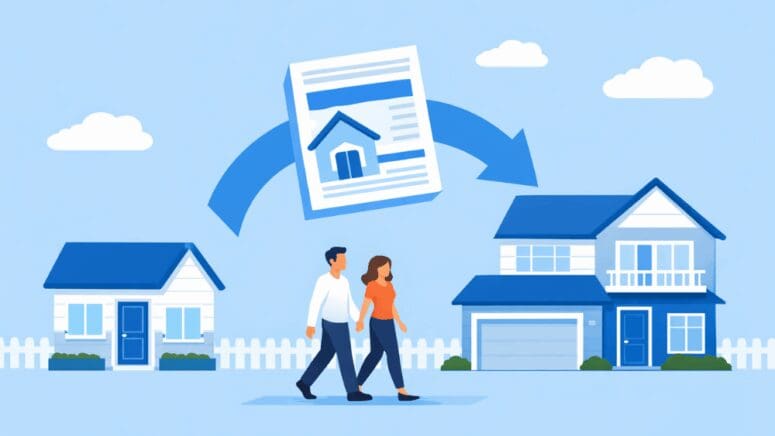
In simple terms, instead of paying off your current mortgage balance and starting over at today’s rates, you transfer that mortgage debt to your next home.
“If the new property is more expensive, you have to cover the difference with cash or equity,” Chester says. “But you’re essentially able to lock in your existing rate and take it with you.”
In most real-world portability programs, the original home must be sold within a set timeframe. We’ll share an example scenario and a portable mortgage calculator you can try later in the post.
How portable mortgages are supposed to work
While the exact rules vary by country and lender, the core mechanics of a portable mortgage are fairly straightforward.
When a homeowner moves:
- The remaining balance on their existing mortgage is transferred to the new home
- The original interest rate applies to that ported portion
- Any additional borrowing needed is handled separately, typically at current rates
From a lender’s standpoint, the borrower doesn’t automatically get a free pass. Chester notes that qualification still matters.
“A consumer would still have to qualify for that mortgage,” he says. “They would still be evaluated. It’s really about validating that the consumer is in the same or a better position than when they originally got the mortgage.”
Operationally, however, this is where uncertainty creeps in, especially in the U.S.
“We haven’t done portable mortgages in the United States,” Chester says. “There could be some risk with title issues because you’re transferring things, and it may not go under the same scrutiny. We don’t know that yet because it hasn’t been designed here, so it’s difficult to fully forecast what the risk would be.”
That lack of a tested framework is one reason portability remains theoretical for U.S. buyers today.
Why portable mortgages exist in other countries
In countries where portable mortgages are available, the goal isn’t novelty, it’s affordability.
“The problem they’re designed to handle is keeping the housing payment low,” Chester explains. “The consumer gets in with a great interest rate on a certain amount of money, and it helps keep their mortgage debt reasonable and their payment reasonable.”
In Canada, for example, mortgages are often structured around shorter renewal periods (5 years is the most common term), which can make portability easier to implement within the broader lending system. Even so, the underlying purpose remains the same: allowing homeowners to move without completely resetting their financial footing.
That coveted purpose — preserving affordability while enabling mobility — is what’s driving new interest in portable mortgages as many U.S. homeowners remain sidelined by today’s higher rates.
Who benefits most from mortgage portability
Mortgage portability isn’t designed to help everyone equally. According to Chester, the biggest beneficiaries are homeowners who locked in historically low rates and have built substantial equity since then.
“The consumers that would benefit the most are those people who got in during market lows,” he says. “If they bought their house during the market low, they have a historic interest rate, and they’re able to move that debt to their next asset.”
This group often includes:
- Homeowners who bought or refinanced before, during, or shortly after the COVID-19 pandemic
- Long-term owners with strong appreciation in their current home
- Move-up buyers who need more space but hesitate to reset their mortgage at today’s rates
First-time buyers, by contrast, wouldn’t see any benefit from portability because they don’t have an existing mortgage rate to carry forward.
In short, mortgage portability primarily favors homeowners who already hold a low-rate advantage and want a way to preserve it while making a move.
Example: How a portable mortgage could work
To see how mortgage portability might work in practice, consider this simplified example.
Imagine a homeowner with a $300,000 mortgage at a 3% interest rate. They want to move to a new home priced at $500,000, but hesitate because current mortgage rates are significantly higher.
With a portable mortgage, the homeowner could carry their existing $300,000 loan — and its 3% rate — to the new home. The remaining $200,000 needed to complete the purchase would be financed separately at the current market rate.
Instead of taking out one large new mortgage entirely at today’s rates, the homeowner ends up with:
- A ported portion that keeps the lower original rate
- An additional loan portion at the higher current rate
The total monthly payment reflects a blend of the two, which could be meaningfully lower than financing the full $500,000 purchase at today’s rates. In most real-world portability programs, the original home would also need to be sold within a set timeframe to complete the transaction.
This type of scenario helps illustrate why portability is appealing to homeowners who feel “stuck” in their current home due to their low rate.
Try the portable mortgage calculator
Because portable mortgages aren’t currently offered in the U.S., it can be hard to picture how this concept would translate to real numbers. That’s where HomeLight’s portable mortgage calculator comes in.
The calculator lets you model a hypothetical portability scenario using your own estimates, including your current mortgage balance, interest rate, and the price of the home you’d like to buy. It then shows how carrying a low-rate loan forward, combined with a new loan at today’s rates, could affect your monthly payment.
Use the calculator below to explore how mortgage portability might change the math if it were ever introduced in this country.
How mortgage portability could affect U.S. homeowner behavior
If mortgage portability were introduced in the U.S., its biggest impact might be psychological as much as financial.
Chester believes portability could motivate homeowners who are currently sitting on very low interest rates to reconsider moving — especially those who feel stuck despite needing more space or a different home layout.
“It might mobilize people who are at low interest rates,” he says. “It might inspire them to move to a nicer property. I think that’s probably the greatest potential impact — to give a percentage of the population sitting on excellent mortgage rates a real incentive to move.”
According to the data experts at Cotality (formerly CoreLogic), more than half of U.S. homeowners have mortgage rates below 4%. Many of these homeowners are reluctant to sell even if they need to upsize or downsize. Portability could reduce that hesitation by allowing them to keep at least part of their low-rate debt intact.
That said, portability wouldn’t automatically unlock a wave of listings. Homeowners would still need enough equity, income, and — perhaps most importantly — confidence in the housing market and economy.
Why portable mortgages aren’t available in the U.S.
While the idea of mortgage portability may sound appealing to consumers, Chester believes the biggest obstacle in the U.S. isn’t risk — it’s incentive.
“The challenge here is how lenders turn a profit,” he says. “It’s similar to an assumable mortgage. The mortgage industry doesn’t make a lot of money when a consumer assumes a mortgage.”
In the U.S., assumable FHA and VA loans already offer a limited version of rate transferability, but they aren’t widely promoted because lenders earn very little when those loans change hands.
“Consumers aren’t paying much to get those services,” Chester explains. “Nobody’s really making money.”
That raises a fundamental question: If portable mortgages are inexpensive for consumers, where does the financial upside come from for lenders, servicers, or investors? And if they’re expensive, would consumers still see them as a win?
Until that middle ground is clearly defined, portability is likely to remain an idea under discussion rather than a product on the U.S. lender shelf.
Tradeoffs and limitations buyers should understand
Even if mortgage portability were available in the U.S., it wouldn’t guarantee a better financial outcome for every homeowner. Chester notes that many homeowners who locked in low rates also benefited from buying before home prices surged.
“They’re stepping into the value of money in today’s dollars versus the value they got in 2019,” he says. “That would probably be the biggest trade-off.”
In other words, portability may preserve a low rate, but it doesn’t protect buyers from higher home prices or reduced purchasing power.
Other limitations to keep in mind:
- Borrowers would still need to qualify based on income, credit, and debt
- Portability wouldn’t eliminate the need for a new loan if the next home costs more
- Real-world programs would likely include caps, timelines, and eligibility rules
Mortgage portability could help with affordability at the margin, but it wouldn’t erase broader market pressures.
Unlock Your Equity and Buy Before You Sell
Through our Buy Before You Sell program, HomeLight can help you unlock a portion of your equity upfront to put toward your next home. You can then make a strong offer on your next home with no home sale contingency.
Are portable mortgages coming to the U.S.?
Mortgage portability has entered the policy conversation as housing affordability remains a national concern. For homeowners feeling locked in by low rates, the concept offers a compelling “what if.”
Chester is cautiously open to the idea, but realistic about its challenges.
“I think it’s a nice idea,” he says. “Will it ever get traction? I don’t know.”
He believes the future of portability depends on whether the industry can find a structure where both consumers and lenders benefit.
“If that question can be answered, you’ll see people get behind it,” Chester says. “If it can’t, then what’s the incentive for the real estate industry and the mortgage industry as a whole to bring that to market?”
For now, portability remains a theoretical solution rather than an available one, but it highlights how much demand there is for ways to move without starting over financially.
What U.S. buyers can do instead
Even without mortgage portability, homeowners still have options to explore when planning a move. Understanding your equity position, comparing scenarios, and getting expert guidance can help clarify what’s realistic in today’s market.
Start by consulting with a top agent
One place to start is by talking with a knowledgeable local real estate agent who understands both pricing dynamics and financing constraints in your area.
HomeLight’s free Agent Match platform can connect you with top-performing agents based on your goals, timeline, and location, whether you’re considering a move now or just weighing your options. We analyze over 27 million transactions and thousands of reviews to determine which agent is best for you based on your needs.
Consider a buy before you sell program
If the idea of mortgage portability appeals to you because you want to move without feeling financially boxed in, there are options available today that can help. HomeLight’s Buy Before You Sell program is designed for homeowners who need flexibility when moving.
A buy before you sell program allows you to unlock the equity in your current home, make a strong, non-contingent offer on your next home, and sell on your timeline — without the pressure of juggling two mortgages or rushing a sale. While portable mortgages remain hypothetical in the U.S., Buy Before You Sell offers a practical way to move forward with confidence in today’s market. Watch the short video below to learn more.
Mortgage portability may or may not become a reality in the U.S., but having the right expertise and modern programs on your side can help you make informed decisions no matter how the market evolves.
Visit HomeLight’s Buyer or Seller resource centers, where you can search for answers to all your real estate questions.
- "President Trump’s portable mortgage push could let you keep your 3% rate, but experts warn it may backfire," Yahoo! Finance (December 2025)
- "What is porting a mortgage in Canada—and when should you do it?," MoneySense (August 2024)
- "The sellers' paradox," Cotality (October 2025)
- "Consumer Opinion Surveys: Composite Consumer Confidence for United States," Federal Reserve Bank of St. Louis (December 2025)
At HomeLight, our vision is a world where every real estate transaction is simple, certain, and satisfying. Therefore, we promote strict editorial integrity in each of our posts.