
10 Most Affordable Cities to Buy a Home in 2026
- Published
- 11 min read
-
 Richard Haddad Executive EditorClose
Richard Haddad Executive Editor
Richard Haddad Executive EditorClose
Richard Haddad Executive EditorRichard Haddad is the executive editor of HomeLight.com. He works with an experienced content team that oversees the company’s blog featuring in-depth articles about the home buying and selling process, homeownership news, home care and design tips, and related real estate trends. Previously, he served as an editor and content producer for World Company, Gannett, and Western News & Info, where he also served as news director and director of internet operations.
Buying a home remains challenging for many Americans as mortgage rates and home prices continue putting pressure on household budgets. Still, how much you can afford often depends on where you choose to live, and — if you have a choice — some cities offer opportunities to get more house for your money.
To identify the most affordable markets, WalletHub compared nearly 300 U.S. cities across factors including housing affordability, market conditions, cost of living, quality of life, and even vacancy rates.
The result is a list of cities where homeownership may be more attainable than in many other parts of the country. We’ll highlight WalletHub’s 10 most affordable cities to buy a home in 2026, but also provide interactive maps where you can explore affordability in other parts of the country.

Looking to Buy a Home in a More Affordable City?
If you are looking to relocate to a more affordable city to buy a home, look no further. Work with a top agent to make homeownership a reality. HomeLight analyzes millions of transactions and thousands of reviews to determine which agent is best for you based on your needs.
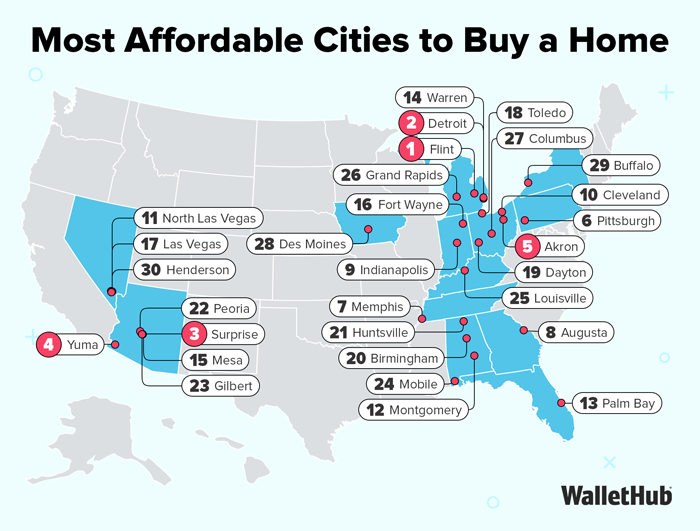
Source: WalletHub
1. Flint, Michigan
Flint earned the top spot in WalletHub’s affordability rankings, reflecting its combination of relatively low housing costs and strong homeownership accessibility compared with many larger U.S. markets.
Located about an hour northwest of Detroit, Flint has worked to diversify its economy beyond its manufacturing roots while retaining a cost of living that remains below many national benchmarks. Buyers often find they can purchase larger homes or more land here than they could afford in many higher-priced metropolitan areas.
The city is home to institutions such as the University of Michigan-Flint and enjoys convenient access to outdoor recreation throughout Genesee County. Residents can also take advantage of nearby parks, trails, and lakes while remaining within driving distance of Detroit’s employment and entertainment opportunities.
For buyers prioritizing affordability above all else, Flint stands out as one of the nation’s most budget-friendly housing markets.
2. Detroit, Michigan
Just an hour away from Flint, Detroit ranked second overall, demonstrating that affordability can still be found in one of the Midwest’s largest metropolitan areas.
Known as the Motor City, Detroit remains a major center for manufacturing, mobility innovation, healthcare, and technology. The city’s housing costs remain relatively modest compared with many large U.S. metros, helping buyers enter the market at a lower price point than they might find in coastal cities or rapidly growing Sun Belt markets.
Detroit also offers a wide range of housing options, from historic neighborhoods with early 20th-century architecture to newly revitalized districts that have attracted investment in recent years. Popular destinations such as the RiverWalk, downtown entertainment district, and professional sports venues contribute to the city’s appeal.
3. Surprise, Arizona
Surprise may not be as widely known as nearby Phoenix or Scottsdale, but the fast-growing West Valley community ranked third for affordability in WalletHub’s study.
Located roughly 25 miles northwest of downtown Phoenix, Surprise has attracted homebuyers looking for comparatively attainable housing within the broader Phoenix metropolitan area. The city has experienced steady population growth over the past two decades, driven in part by new residential development and expanding local amenities.
According to Golf Digest, there are 64 courses within a 15-mile radius of Surprise. Residents also enjoy easy access to parks, spring training baseball, and outdoor recreation throughout central Arizona. The city is also known for its large active-adult communities, although housing options are available for a variety of lifestyles and household sizes.
If you want to live in the Phoenix region without paying some of the area’s highest home prices, Surprise might be ‘surprisingly’ affordable.
4. Yuma, Arizona
Yuma secured the fourth spot on WalletHub’s list, highlighting a housing market that remains relatively affordable while offering year-round sunshine and a strong local economy.
Situated in Arizona’s southwestern corner near the borders of California and Mexico, Yuma serves as an important center for agriculture, military operations, and cross-border commerce. The area’s economy benefits from the presence of Marine Corps Air Station Yuma, one of the region’s largest employers.
Many residents are drawn to Yuma’s warm climate, extensive outdoor recreation opportunities, and lower housing costs compared with larger Arizona cities. The city also offers access to the Colorado River, nearby desert landscapes, and a variety of winter-season activities that attract seasonal residents each year.

5. Akron, Ohio
Akron ranked fifth in WalletHub’s affordability study, continuing a trend seen across several Midwestern cities where homeownership remains within reach for many buyers.
Located between Cleveland and Canton, Akron combines relatively affordable housing with access to a diverse regional economy. The city has evolved from its historic rubber-manufacturing roots into a hub for healthcare, education, advanced manufacturing, and research. Major employers such as Akron Children’s Hospital, the University of Akron, and Summa Health help support the local workforce.
Many homebuyers appreciate Akron’s established neighborhoods, historic homes, and housing inventory that can offer more square footage for the price than many larger metropolitan areas. The city is also known for its proximity to outdoor attractions, including the Cuyahoga Valley National Park and the extensive Summit Metro Parks system.
While affordability is a major draw, Akron also offers convenient access to Cleveland’s employment centers, cultural institutions, and professional sports, making it an appealing option.
6. Pittsburgh, Pennsylvania
Pittsburgh earned the No. 6 spot thanks to a housing market that remains relatively affordable compared with other major metropolitan areas.
Once known primarily for steel production, Pittsburgh has transformed into a center for healthcare, higher education, robotics, technology, and financial services. Institutions such as Carnegie Mellon University and the University of Pittsburgh have helped fuel innovation and attract employers, while healthcare giant UPMC remains one of the region’s largest economic drivers.
Despite this growth, housing costs have generally remained more accessible than in many peer cities. Buyers can find everything from historic rowhouses and classic brick homes to modern condominiums and suburban developments throughout the metro area.
The city also offers a strong quality of life, with walkable neighborhoods, riverfront parks, vibrant cultural districts, and easy access to outdoor recreation.
7. Memphis, Tennessee
Memphis ranked seventh overall, offering homebuyers one of the more affordable entry points among larger cities in the South.
Situated along the Mississippi River, Memphis is widely recognized for its contributions to American music history, but it also serves as a major transportation, logistics, healthcare, and distribution hub. The city benefits from the presence of FedEx’s global air hub and a network of transportation infrastructure that supports thousands of jobs throughout the region.
Housing affordability remains one of Memphis’ biggest advantages. Compared with many fast-growing Southern metros, buyers may find more attainable home prices and lower barriers to homeownership. The market includes a mix of historic neighborhoods, suburban communities, and newer developments that appeal to a range of budgets and lifestyles.
Beyond housing, residents enjoy a rich cultural scene anchored by attractions such as Beale Street, Graceland, and the National Civil Rights Museum.
8. Augusta, Georgia
Augusta secured the eighth position in WalletHub’s rankings, combining relatively affordable housing with a stable economy and growing population.
Perhaps best known as the home of the annual Masters Tournament, Augusta offers far more than world-famous golf. The city serves as a regional center for healthcare, government, cybersecurity, and military activity, supported in part by nearby Fort Gordon and a growing concentration of cybersecurity employers.
Many buyers are attracted to Augusta’s lower housing costs compared with larger Southeastern cities, as well as its slower pace and family-friendly neighborhoods. The local market includes a range of options, from historic homes near downtown to newer suburban developments throughout the metropolitan area.
Residents also enjoy access to the Savannah River, recreational trails, cultural attractions, and a steadily expanding dining and entertainment scene.
9. Indianapolis, Indiana
Indianapolis ranked ninth on WalletHub’s list, reflecting its reputation as one of the Midwest’s most affordable large cities.
As Indiana’s capital and biggest city, Indianapolis combines a diverse economy with housing costs that remain below many national averages. Major industries include healthcare, life sciences, manufacturing, technology, logistics, and professional services, helping attract both employers and new residents.
The city’s housing market offers a wide variety of choices, including historic homes near downtown, established suburban neighborhoods, and new-construction communities throughout the metro area. Buyers relocating from higher-cost regions often find that their budgets stretch considerably further in Indianapolis than in many coastal markets.
In addition to affordability, residents benefit from a growing culinary scene, extensive park systems, professional sports franchises, and nationally recognized events such as the Indianapolis 500.
10. Cleveland, Ohio
Rounding out WalletHub’s top 10 is Cleveland, another Midwest city where housing affordability attracts homebuyers.
Located on the southern shore of Lake Erie, Cleveland has long been a center for healthcare, manufacturing, finance, and education. The city is home to world-renowned institutions such as the Cleveland Clinic, Case Western Reserve University, and Cleveland State University, all of which contribute significantly to the local economy.
Housing remains comparatively affordable across many Cleveland neighborhoods and surrounding suburbs, giving buyers access to a range of home styles and price points. From historic homes in established communities to newer developments in growing suburbs, the market offers options for first-time buyers, move-up buyers, and downsizing retirees alike.
Beyond affordability, Cleveland offers lakefront recreation, professional sports, a respected arts and cultural scene, and one of the largest theater districts in the country outside New York City.
Interactive affordability rankings map
Hover over any of the 300 locations on the map below to see its affordability ranking.
How U.S. home prices have changed since 1960
While affordability varies (sometimes significantly) from one market to another, national home prices have risen dramatically over the past several decades. Here’s a look at how the median U.S. home price has changed over time:
| Year | Median home price | Year | Median home price |
| 1960 | $11,900 | 2000 | $165,300 |
| 1965 | 20,200 | 2005 | $232,500 |
| 1970 | $23,900 | 2010 | $222,900* |
| 1975 | $38,100 | 2015 | $289,200 |
| 1980 | $63,700 | 2020 | $329,000 |
| 1985 | $82,800 | 2024 | $426,800 |
| 1990 | $123,900 | 2025 | $423,100 |
| 1995 | $130,000 | 2026 | $403,200 |
*The 2008 housing market crash took median home prices from a high of $257,400 the year before to a low of $208,400 in 2009. Source: Federal Reserve Economic Data (Q1prices)
See what you may be able to afford
Finding an affordable city is only part of the homebuying equation. Your income, existing debt, down payment, mortgage rate, and monthly expenses all influence how much house you may be able to comfortably afford.
Even among the cities on this list, housing costs can vary significantly by neighborhood, home size, and property condition. A home that feels affordable in one market may stretch a buyer’s budget in another once taxes, insurance, and financing costs are factored in.
Use HomeLight’s Home Affordability Calculator below to estimate how much home you may be able to purchase based on your financial situation. The calculator lets you start with your annual income, or you can toggle to explore the maximum monthly payment you can afford.
To learn more, see our post: 10 Rules of Thumb to Determine How Much House You Can Afford.
Least affordable cities to buy a house
In WalletHub’s 2026 report, these 10 cities were ranked as the least affordable:
292. San Francisco, CA
293. New York, NY
294. Pasadena, CA
295. Los Angeles, CA
296. Berkeley, CA
297. Glendale, CA
298. Costa Mesa, CA
299. Santa Monica, CA
300. Santa Barbara, CA
For the complete methodology and full rankings, visit WalletHub’s original report.
Affordable homeownership opportunities still exist
WalletHub’s rankings show that affordable housing opportunities remain available across several regions of the country.
Before deciding where to buy, consider not only home prices but also employment opportunities, taxes, insurance costs, and overall quality of life.
If you’re planning a move, use a home affordability calculator to better understand your budget and connect with a knowledgeable local real estate agent who can help you evaluate your options in today’s market.
HomeLight’s free Agent Match platform can connect you with top-rated local agents who understand your target market and can help you navigate the homebuying process. We analyze over 27 million transactions and thousands of reviews to determine which agent is best for you based on your needs.
If you are already a homeowner, check out HomeLight’s Buy Before You Sell program. This modern solution unlocks your equity and streamlines the process. Make a non-contingent offer on your new home and only move once. Watch this short video to learn more.
Header Image Source: (dropthepress@gmail.com/ Depositphotos)
At HomeLight, our vision is a world where every real estate transaction is simple, certain, and satisfying. Therefore, we promote strict editorial integrity in each of our posts.