
How to Market Your House for Sale in 2026
- Published on
- 15 min read
-
 Adrian E. Hirsch, Contributing AuthorClose
Adrian E. Hirsch Contributing Author
Adrian E. Hirsch, Contributing AuthorClose
Adrian E. Hirsch Contributing AuthorAdrian E. Hirsch is a South Louisiana interviewer, writer, editor, blogger and scriptwriter. She’s covered the region’s unique lifestyle, landmarks, architecture, art, antiques, food, music, pets and healthcare issues for the Los Angeles Times Syndicate, New Orleans, Memphis and Gambit magazines among others. Having bought, sold and built homes, she’s survived the whims of the market, contractors, kids, rescued cats and dogs—not to mention hurricanes, erosion and termite invasion. Her real estate reporting aims to help families find the right home and maximize the potential of that major investment.
-
 Richard Haddad, Executive EditorClose
Richard Haddad Executive Editor
Richard Haddad, Executive EditorClose
Richard Haddad Executive EditorRichard Haddad is the executive editor of HomeLight.com. He works with an experienced content team that oversees the company’s blog featuring in-depth articles about the home buying and selling process, homeownership news, home care and design tips, and related real estate trends. Previously, he served as an editor and content producer for World Company, Gannett, and Western News & Info, where he also served as news director and director of internet operations.
Gone are the days of historically low mortgage interest rates, buyers waiving all concessions, and shorter selling timelines that defined the pandemic market for two years. From a 16-day average days-on-market in 2021 to 47-62 days in the third quarter of 2025, we are seeing the slowest pace in 10 years. Potential buyers have taken a wait-and-see approach to the single-family home market, as high mortgage rates have placed affordability constraints on their purchasing decisions.
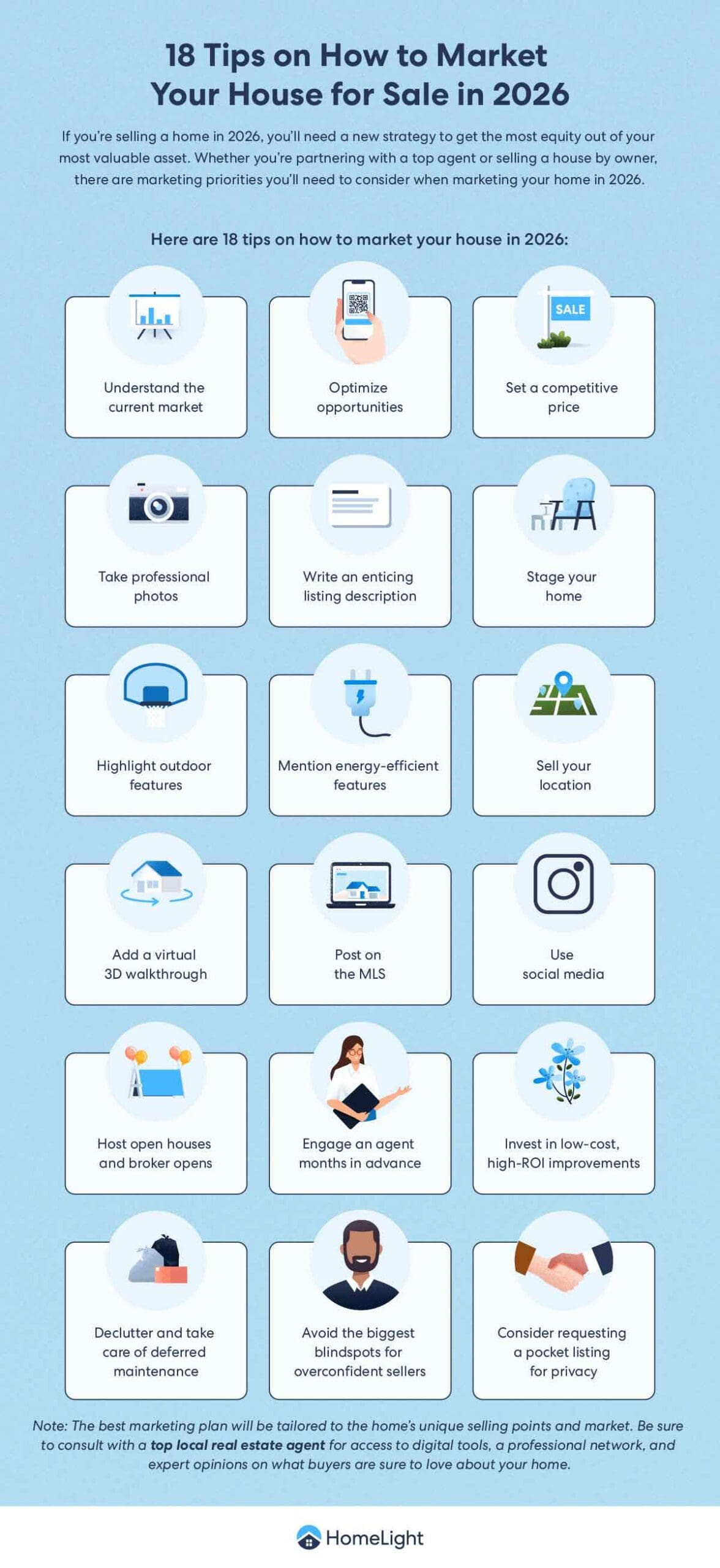
So, if you’re selling a home in 2026, you’ll need a new strategy to get the most equity out of your most valuable asset.
Fortunately, you don’t have to navigate the market alone. We’ve surveyed HomeLight’s top-performing agents nationwide and harnessed their collective expertise to create a guide on how to market your house for sale.
When you hire the right Realtor, that professional will collaborate with you to develop a data-driven marketing plan that appeals specifically to buyers in your area.
Whether you’re partnering with a top agent or selling a house by owner, these are the marketing priorities you’ll need to consider to market your house in 2026.

Step One to Marketing Your Home
Find out what it’s worth! Get a near-instant real estate house price estimate from HomeLight for free. Our tool analyzes the records of recently sold homes near you, your home’s last sale price, and other market trends to provide a preliminary range of value in under two minutes.


Understand the market
When it comes to market trends, mortgage interest rates are the elephant in the room. After two years of historically low rates, the Federal Reserve raised mortgage interest rates eleven times since March 2022 to combat inflation. For 14 consecutive months, the federal funds rate has remained constant after its last raise in July 2023. The Fed has since implemented five rate cuts from September 2024 to October 2025.
Today’s 6%-6.5% rate on a 30-year fixed mortgage pales in comparison to the 18.63% Americans paid in 1981. Still, in a recent HomeLight survey, top agents said more buyers are getting cold feet because of high interest rates and insurance premiums. In the current market, 40% of agents report that somewhat more home sales are falling through.
Experts predict that when rates drop, the 2026 housing market will see more activity.
“If there is an interest rate drop to 5.75% or lower, I believe that we will see a very, very swift increase in buyer activity and buyer motivation to purchase,” shares Stacy Dillard, a Tampa Bay area agent with 30 years of experience.
Optimize opportunities
Despite the changing market, now is a good time to sell a home, especially for homeowners who have a lot of equity in their current home.
With more inventory available, in part because of new construction completed to address the high demand for homes in certain areas during the pandemic, sellers are faced with a challenging market in which to sell their house. Your home has to shine and capture the attention of the right buyers – enough to convince them that your house is the one.
It has to be ready for new homeowners to move in. One-third of agents say vacant homes sell significantly or somewhat faster, and with the demand for turnkey homes, seller preparation is key.
Agents say most of the buyers in this market already own a home and are planning to buy a second one. According to HomeLight’s survey respondents, 80% of buyers own 75% or more of their current home. Tools such as bridge loans and buy-before-you-sell programs are valuable in facilitating the transition to their new home, selling their previous home vacant, and securing higher proceeds from the sale.


Set a competitive price
According to a survey by the National Association of Realtors (NAR), homeowners are taking their time before selling, choosing to stay in their home for an all-time high of 11 years.
The NAR survey revealed that 50% of buyers purchased a newer home. An overwhelming number of agents (76%) also shared in HomeLight’s survey that the biggest selling point for buyers in today’s market is a home in move-in-ready condition.
You can have the glossiest listing in the market and still have a hard time selling if you don’t set the right asking price. According to HomeLight’s survey, 82% of top real estate agents across the country reported an increase in price cuts during the second quarter of 2025 compared to the same time in 2024. Overpricing is the biggest seller mistake, says 77% of surveyed agents. Conversely, if you enter the market with an appropriately priced home, you may receive multiple — and higher — offers within a short time.
To quickly get an idea of your home’s value in the current market, you can fill out the short questionnaire on HomeLight’s free Home Value Estimator and receive a preliminary estimate in less than two minutes. Think of this tool as a starting point to get oriented with price trends in your area.
Follow up your estimate with a comparative market analysis (CMA) from your real estate agent.
A CMA takes into account the price of recently sold properties in your area with similar square footage, overall condition, and number of bedrooms and baths. The agent also factors in recent upgrades and unique selling points like water views or extra land.
Tip: If you haven’t hired a real estate agent yet, HomeLight would be happy to introduce you to some highly qualified candidates in the area. Our data shows that the top 5% of real estate agents sell homes for as much as 10% more. Get matched with a top agent today and ask about getting a free CMA.
Many agents consider pricing a house correctly to be the most important element of a marketing strategy. If your price is too high, your house could sit on the market too long and eventually sell for less. If your price is too low, you could undersell it and forfeit significant value.
“We are no longer ‘pushing the market’ up (using the highest priced sold comparable properties and pricing just a little higher); we are now ‘chasing the market’ down (selecting the mid-range sold comparable properties and rounding down) to get offers,” explains Brenda Noffert, a Wichita, Kansas agent with nearly 30 years of experience.
“Understand the times we are in; so much instability in the workforce, the economy, the government,” advises Aimee Johnson, a top agent in Waldorf, Maryland, with three decades of experience. “Buyers are hesitant after three plus years of massive price increases and unflinching rates. Be aware and make a reasonable plan.”
There might be some benefit to listing just under the market value. Half of HomeLight’s survey respondents say this might help trigger multiple offers. “Pricing just under market will get showings, as buyers are not willing to pay top dollar in this economy,” says Marine City, Michigan, agent Wynne Achatz, who has been pricing homes for 47 years.
Take professional photos
One study found homes with high-quality photographs sell 32% faster than those without visuals. In fact, imagery is so important that most agents have photographers on their list of preferred contractors.
And those photos need to pop in all formats. According to NAR, mobile and tablet searches are the most used information source after agents.
To get the maximum punch per pixel, listing photos need to be magazine quality.
“I insist upon taking exterior photographs of when the house is in its best condition, which is typically May through September,” says Andrew Robinson, a top real estate agent in Powell, Ohio, who sells homes 57% quicker than the average area agent.
That tactic takes on special significance if you plan to enter the market in the winter of a region that’s snow-covered for part of the year. “You want to take extra pictures when the pool is open, so people don’t have a question about what that looks like,” Robinson says.
The easiest way to get quality photos is to work with an agent who contracts with a professional photographer.
DIY tip: If you have patience, time, a great eye, and a DSLR camera and tripod — because no iPhone is up to the job — see this HomeLight post to help develop technique and take a shot at producing passable photos.
Write an enticing listing description
After the photos draw buyers in, your description provides the imagery to amp up buyers’ excitement about seeing the house.
The listing description is usually about a paragraph long and appears alongside the images of your home.
Since buyers can see the number of beds and baths, room dimensions, and year the home was built appear in the data fields, this is your shot to tell your home’s story.
“If the house borders on a waterfront, golf course, or a nature preserve, and if it’s conveniently located close to freeways or top-ranked schools, that needs to be in the listing description,” says Mary Jo Santistevan, a top real estate agent in Phoenix, Arizona.
You want to paint a picture in the buyer’s mind about what makes your house special. Maybe it’s a mid-century modern with the original terrazzo floors, or a craftsman cottage within walking distance of campus.
Learn more: HomeLight’s experts have sharpened their pencils to give you the cliff notes on the steps to write a creative listing.
Stage your home
Staging has become a pivotal step in the selling process. Agents say professional staging can help sellers take home an additional $13,477. By carefully arranging furniture, decluttering spaces, and incorporating tasteful decor, homeowners can create a welcoming ambiance that helps buyers envision themselves living within your walls.
The emotional connection buyers develop with a well-staged home may not only shorten the time it spends on the market but also result in higher offers. Professional staging is one of the best ways to present a home and sell for a higher price. Nationally, 17% of agents surveyed by HomeLight always recommend staging. In areas with a higher price tag, more agents (36%) recommend always staging for the best return.
Aside from the potentially higher selling price, staging also helps sell a house 1-2 weeks faster, according to 34% of agents.


Highlight outdoor features
Skipping curb appeal improvements is another costly preparation mistake to avoid, says top agents. Since the pandemic, Americans have embraced the outdoors like never before as a place to relax, gather, and entertain — making outdoor living areas a homebuyer priority.
“Buyers make quick decisions, and first impressions matter more than ever,” advises Braden Johnson, a top agent serving the Southeast Valley of the Phoenix, Arizona, region.
Take inviting photographs of your yard for your listing, and consider drone footage or an aerial listing to showcase amazing outdoor spaces – especially if your home has coveted features like a pool, firepit, deck, or outdoor kitchen.
Mention energy-efficient features
As the cost of basic utilities such as power and gas increases, Americans are looking for long-term ways to save on housing costs. Recent surveys by Green Builder Media found that a majority of consumers say energy efficiency in their homes is either “very” or “somewhat” important to them, with heat pump HVAC, efficient lighting, and solar systems among the most desired upgrades. While energy-efficient appliances and upgrades can make a home more appealing, sellers need to pay attention to the right upgrades to generate a good return.
According to the 2025 Cost vs Value report, installing a backup generator costs $13,534 and recoups 95% at resale. Converting the HVAC to an electric heat pump costs $19,484 and returns 72%. Meanwhile, solar power installation, which costs $55,937, has a 30% return at resale, though it might be worth mentioning the long-term home value increase.
Sell your location
While real estate listing sites often include a map to show where your property is located, your marketing should make it easy for buyers to learn what’s nearby and how convenient it would be to live there.
In the NAR 2025 Profile of Home Buyers and Sellers, buyers identified the quality of the neighborhood and convenience to family and friends as the most significant indicators of a location’s desirability.
Add a virtual tour or 3D walkthrough
According to the NAR October 2025 Confidence Index, the use of technology prompted 5% of buyers to purchase a home without ever setting foot on the property. They based their decision and made an offer exclusively on a virtual tour, showing, or open house.
“We do 3D tours on $2 million houses and $200,000 houses,” Robinson explains, “because we want buyers to experience what it feels like to walk through the house.”
But, 3D’s advantages don’t translate to all demographics. “If I were showing a listing to my mother,” he says, “it would be better for her to experience that house with the video.”
That’s why Robinson advocates a multimedia approach to marketing.


Post on the MLS and major real estate sites
To reach the largest audience, a home’s data, photos, and description are uploaded on the Multiple Listing Service (MLS), a local or regional database cooperating real estate brokers use to share data and information about properties for sale.
“When a home goes into the MLS, it’s syndicated to all of the other real estate websites,” says Santistevan. That means your agent’s public-facing MLS listing should populate on sites like Zillow, Realtor, Trulia, and Homesnap as well.
Use social media to your advantage
Savvy real estate agents are well-versed in using social media channels for real estate to generate buzz and raise your home’s visibility in your area.
Agents frequently place shareable images and videos on Facebook, Instagram, Nextdoor, and even TikTok to amp up the number of people who see their listings.
You can also complement your agent’s social media strategy with your own. Even if your network is small, it can be mighty.
But don’t forget about the impact that physical signage, brochures, postcards, and print ads can have in your digital pursuit to promote your home. These days, many print ad listings are part of packages that include a digital component, such as Facebook or Instagram listings.
The same text and images you create for a digital campaign can easily be adapted for old-school marketing materials such as signs, brochures, postcards, and print ads.
A for-sale sign is a classic no-brainer to grab the attention of any passersby.
A well-timed postcard gives neighbors advanced notice that you’re ready to sell — and the opportunity to choose their new neighbors by sharing that listing with their friends and family.
Santistevan creates a professional brochure for every client’s home. “You don’t know how many homes buyers are seeing on the same day,” she says. “When they’re reviewing the homes later, that high-quality brochure triggers a positive emotional response.”
Host open houses and broker opens
Besides giving the property more exposure, Suzanne Macnab, a coastal Maryland agent with 41 years of experience, finds open houses offer the opportunity for casual exploration that turns into kismet.
“Sometimes, someone sees an advertisement and comes to an open house — maybe it isn’t exactly the kind of home they’re looking for, or they’re not looking at all — because they’re curious,” she says. “Once they see the property, they end up purchasing the home.”
Brokers’ open houses are another good marketing strategy. Shortly after your listing goes live, your agent might host a gathering of select real estate brokers and agents at your home, so they can investigate whether your property is right for their clients.
NAR data shows that 88% of recent buyers purchased their homes through a real estate agent or broker. So, it’s no surprise a broker’s open is sometimes more lucrative than a traditional open house because it can lead to more private showings and serious offers.
Engage an agent months in advance
Robinson says it’s ideal when clients contact him six months before they plan to sell.
It may seem early, but “now’s the time we can actually help clients put more money in their pocket,” he says, “because we can evaluate the home and give them a 90-day plan of action to economically get their house up to the standards for today’s buyers.”
Invest in low cost, high ROI improvements
“Since homes have become kind of a sanctuary,” says Robinson, “buyers want to make their homes a place where they can work, work out, and entertain.”
Just like there are classic features that never go out of style, there are other elements that are destined for the dustbin of design history.
Robinson reports decor that discourages buyers includes:
- Carpet in a bathroom: “I don’t know why that was ever popular,” he says.
- Dated wallpaper in a room: “It just sends a message that there’s going to be a high investment to get that off,” Robinson says.
- Different types of hardwood flooring in adjacent rooms, such as having an oak floor in the dining room and cherry in the kitchen.
- Jacuzzi tubs in bathrooms.
By contrast, agents nationwide report buyers are impressed by kitchen designs featuring:
- Warm or colorful paint
- Mixed materials
- Earth tones
- Light wood
- Bold colors
- High-tech appliances
With those preferences in mind, it might be tempting to pursue a remodel before your listing.
According to the 2025 Cost vs. Value Report, a mid-range minor kitchen remodel costs about $28,458 and results in an additional $32,141 in resale value. On average, a mid-range bathroom remodel costs about $26,138 and is likely to garner approximately $20,915 at resale.
However, because many buyers prefer to save money on the purchase price and adapt the home to suit their own design aesthetic, Macnab advises homeowners to “avoid over-improving the home.”
Instead, she advocates repairs and improvements that offer a high return on investment, such as punch-list items (see below) that typically cost $300 or less and add an additional $1,000 or more in value.
Declutter and take care of deferred maintenance
Never underestimate the appeal of a decluttered, well-maintained home. If a buyer sees deferred maintenance in one area, it overshadows their decision to invest the highest amount and the offer price.
That may be more important than ever, as the NAR reports millennials comprise 29% of home purchasers. As a generation generally disinterested in family heirlooms, it’s no surprise they’re unwilling to inherit major problems from previous property owners.
Clutter, seller presence, and filth are some of the most overlooked preparations when selling a home. HomeLight agents identify some of the clutter you should remove before selling:
- Anything that isn’t essential for daily living (27%)
- Personal photos and family memorabilia (18%)
- Excess furniture (16%)
- Bulky collections and knick-knacks (12%)
- Outdated or over-the-top décor (7%)
- Clutter in storage areas, such as garages, closets, or the attic (5%)
- Pet supplies and evidence of pets (5%)
- Other, e.g., old rugs, unused exercise equipment (10%)
Avoid the biggest blindspots for overconfident sellers
You never get a second chance to make a first impression — particularly with brokers and buyers. So, before hosting open houses or broker opens, it’s important to make sure your house shines.
These are some of the main reasons a home sale might fall through:
- Home inspection uncovers major issues (27%)
- Seller refuses repair requests or concessions (12%)
- Appraisal comes in below the sale price (6%)
Conversely, here are some of the most common seller concessions or credits that help seal the deal:
- Closing cost credits (58%)
- Price reduction based on inspector findings (20%)
- Seller-paid interest rate buydown (7%)
- Post-closing repair credits (6%)
- Inclusion of personal property or appliances (3%)
Learn more: See our guide for how to prepare your home for sale for more expert tips.
Consider requesting a pocket listing for privacy
This method of marketing a home for sale differs from all the others mentioned so far, and it is only suitable for sellers who prioritize privacy over maximizing the exposure of their listing.
Essentially, a pocket listing is an agreement between a real estate agent and seller to market a home through private connections rather than advertise it publicly.
The key distinction is: The pocket listing does not appear on MLS. Instead, the listing information is retained within a brokerage and shared on an individual basis with clients who may be interested.
When a seller wants to shield the sale from public knowledge for personal or legal reasons, that’s when a pocket listing may be an attractive option.
However, the benefits should be weighed against possible trade-offs, such as difficulty in finding a buyer and accepting an offer below market value.
Tip: If privacy and speed are crucial to your home-selling objective, HomeLight can connect you to the largest network of cash buyers in the U.S. through our Simple Sale platform. You can receive a no-obligation cash offer in 24 hours and close in as little as 7 days.
Ready to market your listing?
When marketing your home for sale, be sure to cover essential home-selling steps such as competitive pricing and home preparations. Consider ways you can help your listing stand out with professional photos and staging.
That said, every home is different. The best marketing plan will be tailored to your unique selling points and market. Consult with a top local real estate agent for access to digital tools, a professional network, and expert opinion on what buyers are sure to love about your home.

Find a Top Listing Agent to Market Your Home
HomeLight makes it easy to connect with a top real estate agent who can develop a marketing strategy tailored to your home. Your agent will be equipped to provide complete service including: professional photography, listing on major online home search sites, open houses, and more.
FAQs for how to market your house
To effectively market your house, start by preparing your home for sale, including cleaning, decluttering, and making necessary repairs. Hire a professional photographer to capture high-quality images, and work with a real estate agent to create a compelling listing. Utilize online platforms and social media to reach a broad audience, host open houses, and consider staging your home to showcase its potential.
Determining the right listing price involves researching recent sales of similar homes in your area (comps), considering your home’s unique features and condition, and consulting with a local real estate agent. They can provide a comparative market analysis (CMA) to help you set a competitive and realistic price that attracts potential buyers.
Staging is not always necessary, but it can significantly impact the selling process. Staged homes tend to look more inviting and help potential buyers envision themselves living there. Professional stagers can rearrange furniture, add decor, and optimize spaces for better presentation, potentially leading to quicker sales and higher offers.
Online marketing is essential in today’s real estate market. Create a compelling online listing with high-quality photos and detailed descriptions. Utilize popular real estate websites, social media platforms, and email marketing to reach a wide audience. Consider using video tours or 3D virtual tours to provide an immersive experience for potential buyers. Collaborate with your real estate agent to implement effective online marketing strategies.
Header Image Source: (Point3D Commercial Imaging Ltd. / Unsplash)
- "2025 Home Buyers and Sellers Generational Trends Report," National Association of Realtors
- "Younger generations are torn over inheriting boomer heirlooms. Here are 4 helpful tips.," Upworthy (August 2024)
- "2025 Cost vs Value Report," The Journal of Light Construction
- "Highlights From the Profile of Home Buyers and Sellers," National Association of Realtors
At HomeLight, our vision is a world where every real estate transaction is simple, certain, and satisfying. Therefore, we promote strict editorial integrity in each of our posts.