

How Home Valuation Works: Methods, Data Sources & Accuracy
- Updated
- Originally published
- 13 min read
-
 Lori Lovely, Contributing AuthorClose
Lori Lovely Contributing Author
Lori Lovely, Contributing AuthorClose
Lori Lovely Contributing AuthorLori Lovely edited the Real Estate Home section for the Indianapolis Star and covered the annual Dream Home construction and decor for Indianapolis Monthly magazine. She has written guides for selling houses and more.
-
Richard Haddad, Executive EditorClose
Richard Haddad Executive Editor
Richard Haddad is the executive editor of HomeLight.com. He works with an experienced content team that oversees the company’s blog featuring in-depth articles about the home buying and selling process, homeownership news, home care and design tips, and related real estate trends. Previously, he served as an editor and content producer for World Company, Gannett, and Western News & Info, where he also served as news director and director of internet operations.
Your home’s value can change over time as the real estate market shifts, your neighborhood grows, and you make updates to your property. Maybe you’ve remodeled your kitchen, added more living space, or noticed similar homes nearby selling for higher prices and started wondering how your home stacks up. A home valuation can give you a clearer picture of what your property is worth today and help you understand your options.
Knowing your home’s value can help you make more informed decisions, whether you’re getting ready to sell, considering a refinance, or using your equity to fund renovations or other goals. Instead of relying on guesswork, you can use your home’s value as a helpful guide for planning your next move.

A Quick (And Free) Way to Check Your Home Value
Get a preliminary home value estimate in as little as two minutes. Our tool uses information from multiple sources to give you a range of value based on current market trends.
This FAQ sheet and our expert, Desiree Carroll, a top Bethlehem, Pennsylvania agent who has almost two decades of real estate exprience, will guide you through the ups and downs of getting an accurate home value estimate and explain what makes property values fluctuate. We’ll also give you the honest scoop on online valuation tools and what they can (and can’t) tell you about your home’s value.




1. How can I estimate the value of my home?
There’s more than one way to determine the value of your home. Some of the best and easiest include:
- Use an online valuation tool, such as HomeLight’s Home Value Estimator (HVE), or an automated valuation model (AVM)
- Talk to an experienced real estate agent
- Request a professional appraisal
- Check public records
Your choice will depend on your reasons for wanting a home valuation:
- If you just want a rough estimate for your own personal knowledge, using an online valuation tool to get a free home appraisal should be enough.
- If you’re considering accessing your home’s equity in a home equity line of credit (HELOC) or a cash-out refinance, your lender will typically require a third-party appraisal, which can cost several hundred dollars or more.
- If you believe your property taxes are too high, a professional appraisal can provide evidence to support an appeal. Keep in mind that your tax bill is typically based on your local government’s assessed value, not an online estimate or CMA.
- If you want to make sure you have enough insurance coverage, a professional appraisal can help determine your home’s replacement cost. This focuses on how much it would cost to rebuild your home rather than its market value.
- If you’re considering selling your home, consulting a real estate agent is an affordable choice because most professionals provide a comparative market analysis (CMA) as part of their services.
- If you need to divide property during a divorce, a professional appraisal can provide an unbiased valuation that may be used during negotiations or legal proceedings. A CMA may also be helpful if you’re looking for a less formal estimate.
2. How does HomeLight’s online home value estimator work?
HomeLight’s online home value estimator combines details you provide about your property with data from public records and multiple market sources to create a real-time estimate based on current trends. It also asks a few quick questions about your home’s type and condition to make the estimate more personalized, which is something many other online tools don’t take into account.
In addition to the estimate, HomeLight provides a list of top local agents with proven track records for strong sale prices, giving you expert insight into accurate home pricing.
That said, like most online valuation tools, the estimate isn’t exact. While it relies on hard data, it may not fully capture your home’s upgrades, additions, or unique condition.
Cash offer estimate: HomeLight’s valuation also includes the Simple Sale price. With Simple Sale, you can request an all-cash offer to buy your home. If you accept, you can pick the move date and get your home sold fast without the hassle of making repairs and having buyers come into your home. We estimate a home’s Simple Sale offer price to be around 90% of market value.
Find out what your home might be worth in two minutes and connect with a top agent with HomeLight’s Home Value Estimator. Whether you’re simply curious about your home’s ballpark value or using this information as the first step toward refinancing or selling, it’s a helpful place to start.
3. Should I pay for a professional appraisal?
“An appraisal provides the most accurate valuation,” Carroll says. The caveat is that it is one person’s opinion at one moment in time. The appraised value can be very different three to six months later since an appraisal is largely based on what has recently sold in the area.
If you’re considering refinancing your home or are interested in a HELOC, your lender will typically require an appraisal performed by an independent third party. The cost of a professional appraisal varies by region, with appraisals in the Pacific Northwest usually commanding higher prices than in the South.
Thankfully, however, the Dodd-Frank financial reform from 2010 dictates that a professional appraiser’s fees must be reasonable and customary for the geographic market.
Keep in mind that different loan types, like FHA, VA, and conventional, will have different appraisal requirements.


4. Can I get a home valuation from an agent if I’m not selling my home right now?
Most real estate agents provide you with a CMA as part of their listing services. A thorough CMA, which often exceeds 30 pages of detailed examination, is a tool that should provide a professional valuation of your home, comparing your property with similar properties in the neighborhood (known as comps) while taking the current market into account.
Some agents charge $100 to $200 for compiling a CMA, while others offer it for free as a way to earn your business.
“I don’t get paid for a CMA,” Carroll states. She considers it part of relationship building. In an industry based on referrals and client relations, she likes to help past clients in the hope of future business. “Not everything we do is compensated.”
Some states don’t allow real estate agents to get paid for creating a CMA. “You would have to be an appraiser if you’re paid.” Her brokerage (as well as some states) doesn’t even permit its agents to be paid for a Broker Price Opinion (BPO) in which a real estate broker offers a written estimate on a home’s valuation based on expert judgment.
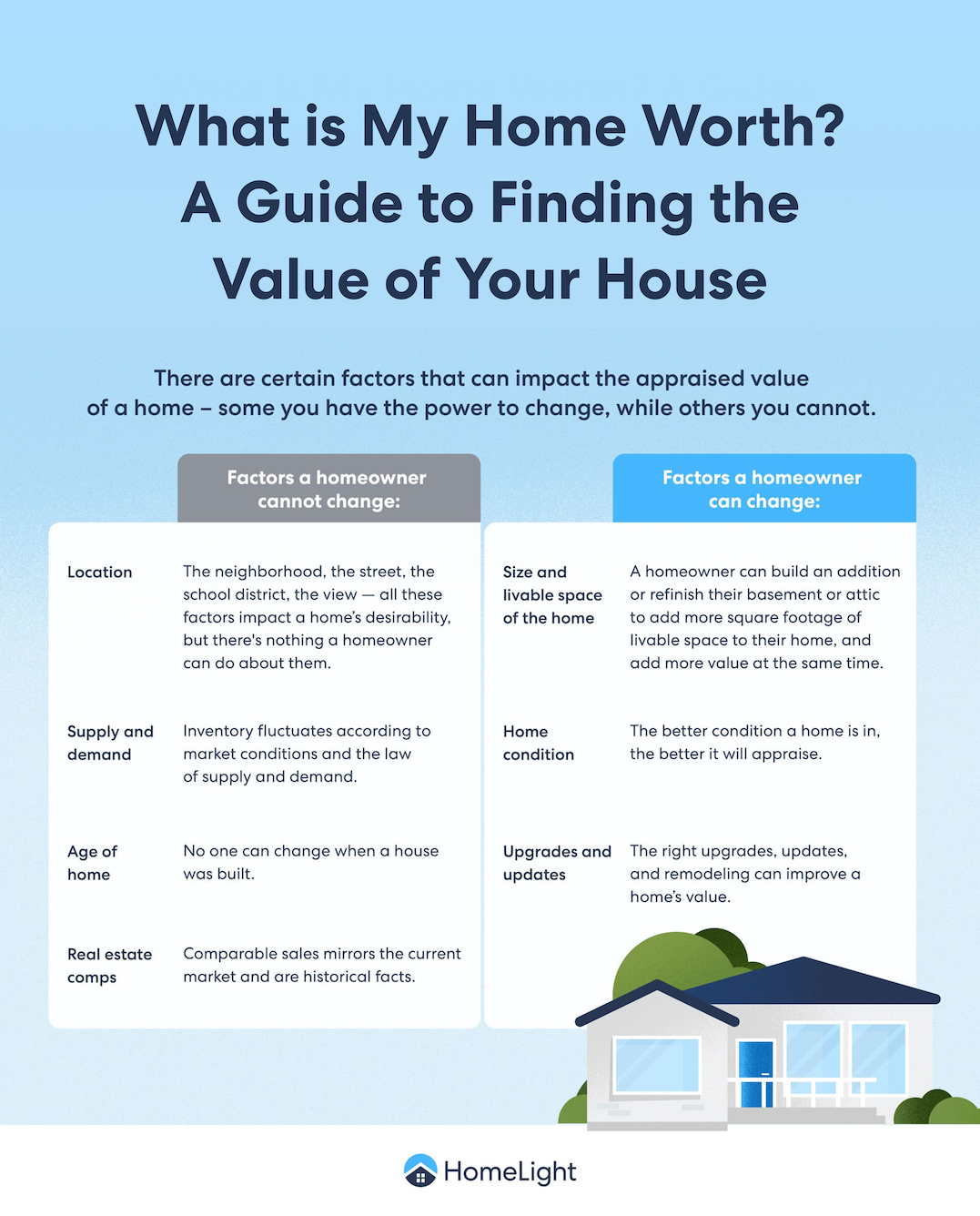
5. What factors impact appraised home value?
Some things increase your home’s value, while others hurt it. There are things on both those lists that cannot be changed, but there are also things on both lists that can be.
Factors that you cannot change
- Location: Your neighborhood, street, school district, and even your home’s view can all affect how desirable it is, but they’re not exactly things you can change. For example, research from the University of Washington found that homes near nature parks and open spaces can be worth 8% to 20% more than similar properties. On the other hand, data from the National Association of Realtors (NAR) shows that 14% of recent homebuyers considered school district quality when choosing a home, and that number jumps to 34% for buyers ages 36 to 45. These factors are out of your control, but they can have a major impact on what buyers are willing to pay for your home.
- Supply and demand: Inventory fluctuates according to market conditions and the law of supply and demand. When supply is low and demand is high, your home’s value will increase. Conversely, when supply is plentiful and demand is low, your home’s value will decrease.
- Home’s age: Everything ages. You can’t change when your house was built. In some cases, an older home can be worth more, due to architectural details lacking in new construction. But its condition is often more important than age.
- Real estate comps: Comparable sales mirror the current market and are historical facts. But because most real estate agents prefer comps no older than six months, it’s a moving target, and as the market fluctuates, so do the comps, reflecting on your home’s value at any given time.
Factors that you can change
- Size and livable space: You can build another story or room, or refinish your basement or attic to expand your home’s square footage of livable space, and add more value to the property. However, note that basement square footage doesn’t add as much value as above-ground spaces and may not be included in your home’s overall square footage. Meanwhile, adding an accessory dwelling unit (ADU) or mother-in-law suite may increase the value of a home by as much as 35%.
- Home’s condition: The better condition your home is in, the better it will appraise. Home appraisers rate your home’s condition based on the amount and degree of repairs required. However, due to limited supply and peak demand, Carroll says the condition is not as “prevalent” as it was five or six years ago.
- Upgrades and updates: The right upgrades, updates, and remodeling can improve your home’s value. For example, well-landscaped homes are worth up to 7% more. Even minor updates like new fixtures and paint can add to your home’s value.
6. Does a messy house affect an appraisal?
Technically, decor, moveable items, and cleanliness aren’t supposed to impact an appraiser’s assessment of your home. Human nature, however, intervenes.
Messy, dirty, or cluttered homes can send the wrong signal, making an appraiser wonder whether the property has been properly cared for over the years. Plus, if clutter gets out of hand, it can limit an appraiser’s ability to see and assess your home, potentially affecting the final appraisal value.
But it all depends on the market, Carroll says. In a seller’s market, a spotless, well-kept home isn’t as important as it is in a buyer’s market.
7. What makes property values go up or down in any given time period?
As mentioned, property values fluctuate over time. There are several reasons for this, including:
- Zoning regulations: Zoning regulations are local rules that determine what you can and can’t do with a property, from the type of buildings allowed to how a home can be expanded or renovated. These rules can impact your home’s value by affecting the neighborhood’s look, future development, and the price buyers are willing to pay. For example, a home in an area with zoning that supports desirable growth may become more valuable, while strict restrictions could limit its potential.
- Interest rates: The rates borrowers pay to finance a home loan rise and fall. When interest rates fall, buyers can borrow more money, and home prices tend to rise. When interest rates rise, buying power decreases, and home prices typically slow their growth or fall.
- Overall state of the economy: The overall health of the economy can have a big impact on home values. Factors like gross domestic product (GDP), job growth, manufacturing activity, and the cost of goods help show how the economy is doing. When the economy slows down, the housing market often follows, which can cause home values to dip, while a strong economy can boost demand and drive values higher.
- Supply chain and material costs: The rising cost and limited supply of lumber, steel, aluminum, and other construction materials drive up housing costs.
- Politics: Politics can impact the economy, particularly if the government stimulates the consumer climate. This could be in the form of legislative action to lower interest rates or tax incentives. Sometimes, the political leanings of a geographic region can impact the value of real estate.
- Disasters: Whether it’s a natural disaster like a hurricane or tornado or a human-caused event like a fire, disasters can affect nearby home values in unexpected ways. In some cases, damaged properties can reduce the available housing supply, increasing demand from displaced homeowners and potentially driving up values for unaffected homes. On the flip side, homeowners who repair or upgrade their properties after a disaster may see their home values increase as a result of those improvements.
- Bidding wars: In a seller’s market, where demand exceeds supply, buyers may bid higher than the list price to win the property. When a home sells for more than its original list price, that higher sale price can become a new comparable for nearby properties, even if the appraisal came in lower. Conversely, in a buyer’s market, where homes are plentiful and demand is low, buyers have more negotiating power, which can push home values down.
If I list a home for $300,000 that sells for $320,000, the comp has just gone up, even if the home appraised at only $275,000.

8. Are home appraisals public record?
In general, home appraisals are not public record. However, some portions of an FHA appraisal are released to an FHA website and may be accessed for up to six months.
In many states, public records will reveal limited information, such as recent sales prices, number of beds and baths, and square footage. However, there are a handful of non-disclosure states in which no information is made public.
In non-disclosure states, sale prices in a real estate transaction are not disclosed or recorded as public record, whether to protect the homeowner’s privacy or the value of the industry’s multiple listing service (MLS).
However, the National Association of Realtors explains on its website that non-disclosure states “cannot withhold sold data from MLS data feeds.” The restrictions only apply to what can be publicly displayed, not the information available through MLS systems.
When there isn’t enough reliable information to figure out what a home is worth, it can sometimes lead to values being underestimated. In these cases, homes may end up being priced lower than they should be because there isn’t enough data to paint the full picture.


9. What will my house be worth in five years?
Carroll likes to say that you never lose in real estate if you hold onto property long-term. Depending on your goals, however, you could lose money if you buy or sell at the wrong time.
Being able to predict your home’s value in five years can help you plan. You can start by consulting the Federal Housing Finance Agency FHFA HPI Calculator to get an idea of what a home previously purchased would sell for today. It takes into consideration the average rate of appreciation of all homes in the area.
The easy-to-use calculator asks you to input your state, the quarter and year you purchased the property, and the original purchase price. It then calculates how your home’s value has increased over the timeframe by referencing appreciation trends for the area.
It’s a ballpark figure. For a truly accurate assessment, ask an experienced agent to provide an opinion that takes into consideration specifics about your property and developments in the neighborhood.
10. What will my house be worth in 10 years?
Historically, median home values have seen a steady price growth increase since the 1960s. Carroll mentions what real estate agents call a “seven-to-ten-year swing,” which refers to the typical housing cycle where prices rise for several years, peak, then cool or decline before beginning another upswing. “I’ve talked to economists. The predictions have been accurate.”
Until COVID-19, that is. The U.S. housing market exceeded the ten-year upswing, in part due to the COVID effect and its ripples in the supply chain. “Once the pandemic hit,” Carroll recalls, “we thought it was [the beginning of] the downturn. But it didn’t happen.”
The housing market took off during the pandemic, but by 2024 to 2026, things started to cool down. Mortgage rates have been hovering around the 6% to 7% range, price growth has slowed to modest gains, and while more homes are hitting the market, inventory is still tight. In a market like this, Carroll advises clients to “strategically think of where you want to be” and try to gauge the market’s future.
Looking at the general trend of America’s home price history can help predict potential trends 10 years in the future. However, even this extensive historical data cannot account for unexpected dips and surges in the market.
Find Your Perfect Real Estate Agent
We analyze over 27 million transactions and thousands of reviews to determine which agent is best for you based on your needs.
»Learn more: Get a better idea of your home’s financial potential with our Home Equity Calculator. Whether you’re thinking about selling, renovating, or just planning, knowing your numbers can help you make smarter decisions.
The best equation to estimate the value of your home
Whether you’re just curious about your home’s value or need an estimate for something more urgent, like refinancing, applying for a home equity loan, checking your property taxes, planning an estate, settling assets, or going through a divorce, you can get a rough idea using an online valuation tool. However, note that AVMs don’t consider upgrades or improvements to your home or neighborhood, which reduces their accuracy.
HomeLight’s Home Value Estimator can be your convenient starting point for a free valuation. For a better idea of your home’s value, HomeLight’s HVE can direct you to a local top real estate agent, who can provide an even better estimate by preparing a CMA that presents a very accurate snapshot of your home’s value.
You can do some research on your own by checking public records, but an experienced agent will likely have a better understanding of the local market and nearby properties. They’ll also have access to additional resources, like the MLS, that can provide more detailed information to help determine a home’s value.
If you want the most accurate idea of what your home is worth, an appraisal is your best bet. A licensed appraiser will take a closer look at your property and provide an unbiased estimate based on the home itself and current market conditions.
Frequently asked questions (FAQs) about home valuation
If your home’s appraisal comes in lower than the buyer’s offer, it could create a gap between what the buyer agreed to pay and what the lender is willing to finance. You may need to renegotiate the price, ask the buyer to cover the difference, or review the appraisal for possible errors. Your agent can help you weigh your options and decide the best way to keep the deal moving.
If you think your home valuation doesn’t accurately reflect your property’s worth, you may be able to challenge it. You can provide additional information, such as recent comparable sales, upgrades, or details about your home’s condition that may have been overlooked. The process depends on the type of valuation and who completed it, but your agent can help guide you through the next steps.
If you’re selling your home, it’s helpful to know that its value can change over time based on market conditions, buyer demand, interest rates, and changes in your neighborhood. Even small shifts in the local market can affect what buyers are willing to pay. Checking your home’s value before listing can help you set a realistic price and create a stronger selling strategy.
If you’re using a home valuation to decide how to price your property, keep in mind that most valuations are not legally binding. Online estimates and CMAs can help you understand your home’s potential value, but they don’t guarantee what a buyer will pay. A professional appraisal is typically used for official purposes, such as mortgage approvals or legal matters.
If you’re selling a home, a value acceptance means the buyer’s lender has accepted an estimated property value without requiring a traditional appraisal. This can happen with certain mortgage loans when the lender’s system determines there’s enough data to support the home’s value. When available, it can help simplify the process and potentially avoid appraisal delays.
Header Image Source: (Jonnelle Yankovich / Unsplash)
At HomeLight, our vision is a world where every real estate transaction is simple, certain, and satisfying. Therefore, we promote strict editorial integrity in each of our posts.