

Real Estate Commission Changes: What Sellers Need to Know
- Updated
- Originally published
- 8 min read
-
 Richard Haddad Executive EditorClose
Richard Haddad Executive Editor
Richard Haddad Executive EditorClose
Richard Haddad Executive EditorRichard Haddad is the executive editor of HomeLight.com. He works with an experienced content team that oversees the company’s blog featuring in-depth articles about the home buying and selling process, homeownership news, home care and design tips, and related real estate trends. Previously, he served as an editor and content producer for World Company, Gannett, and Western News & Info, where he also served as news director and director of internet operations.
If you’re planning to sell your home, you’ve likely heard about the real estate commission changes. Historically, sellers were expected to cover both the listing agent’s commission and the buyer’s agent’s commission, typically totaling 5%-6% of the home’s sale price. However, a landmark court settlement involving the National Association of Realtors (NAR) has reshaped these long-standing practices.
Now, buyers are responsible for paying their own Realtor fees unless they negotiate otherwise. This shift means sellers are no longer automatically on the hook for both agent commissions. But what exactly does this mean for you as a seller?

The Top 5% of Agents Sell Homes for Up to 10% More
HomeLight analyzes over 27 million transactions and thousands of reviews to determine which agent is best for you based on your needs. Connect with your top agent matches today at no cost.
This brief post will break down these changes, how they affect your bottom line, and what you need to consider when listing your home.




What are the real estate commission changes?
The NAR settlement has fundamentally changed the way real estate commissions work. A federal court ruled that the NAR’s long-standing commission rules violated antitrust laws, saying they may have pushed home sellers to cover costs that buyers could have paid themselves. As a result, the way agents discuss and negotiate commissions is now different than it was just a few years ago.
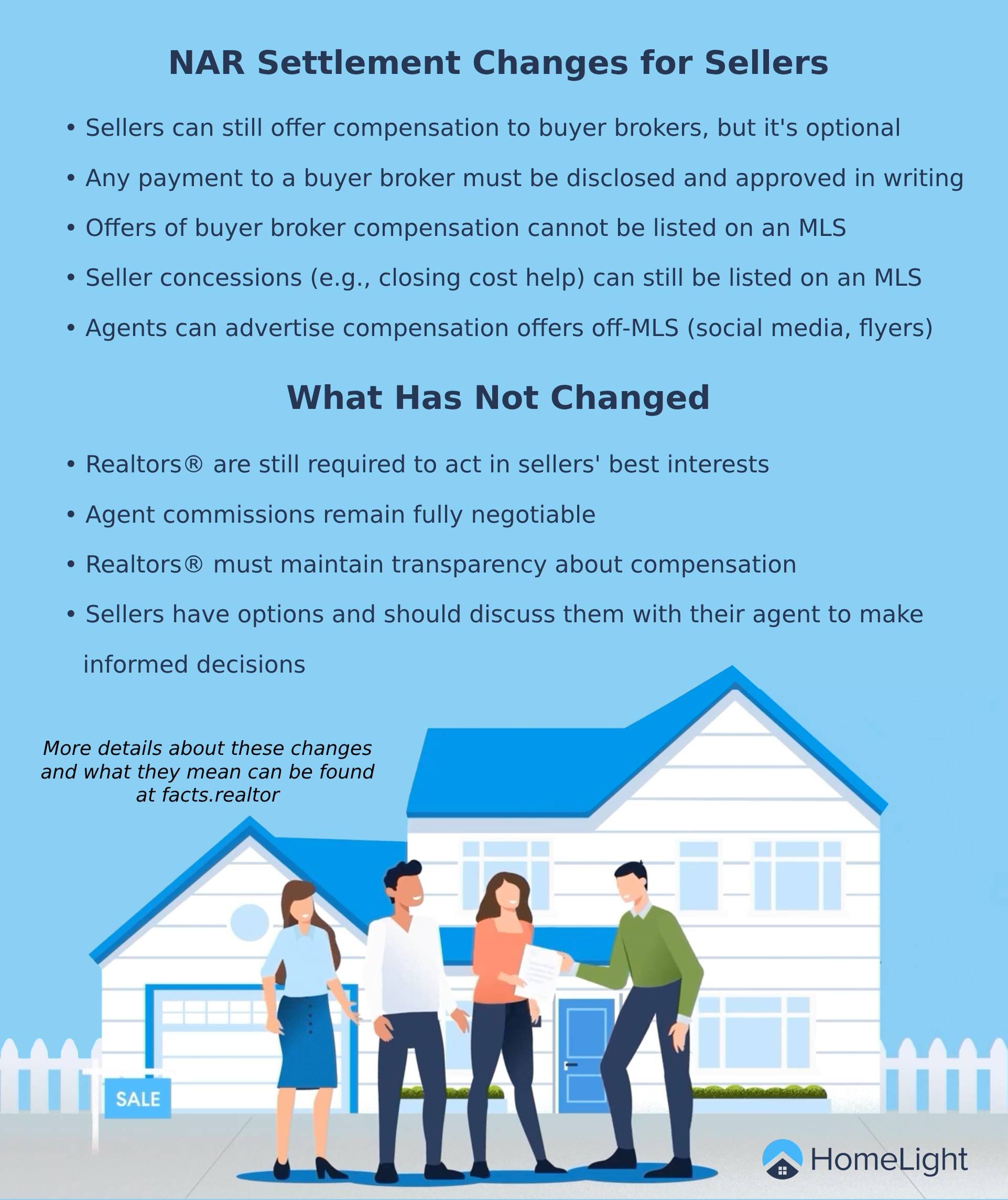
As part of the settlement, NAR agreed to update its rules to make real estate transactions more transparent and give buyers more say in how they pay for agent representation. Here’s a breakdown of what’s changed:
- Buyers are expected to pay their own agent fees: In the past, it was common for sellers to pay both the listing agent’s commission and the buyer’s agent’s commission. Now, buyers are generally expected to negotiate their own agent’s fees and decide how those costs will be paid, though sellers can still agree to cover some or all of the expense as part of the deal.
- Sellers are only required to pay their listing agent’s commission: Instead of paying a combined 5%-6% commission, sellers are now generally responsible for only the listing agent’s fee, which averages around 2.5%-3%.
- Negotiation remains an option: Sellers and buyers can still negotiate commission payments, meaning sellers might still offer to cover the buyer’s agent fee in certain situations to attract offers.
A new requirement for buyers: In addition to being responsible for their own agent fees, buyers shopping for a home must now sign a buyer-broker agreement before touring homes with an agent who has access to the industry’s multiple listing service (MLS). This requirement ensures that everyone is on the same page about who’s doing what and how the agent will be paid before the home search gets underway.
What do these changes mean for sellers?
For sellers, these commission changes bring both benefits and new considerations. Here’s what you need to know:
- Lower automatic commission expenses: Since you’re only responsible for your listing agent’s fee, you could save thousands compared to the traditional model. Example: If you sell a $500,000 home and only pay your listing agent 3%, you’ll spend $15,000 instead of $30,000 under the previous 6% commission structure.
- More room for negotiation: While you’re not required to cover the buyer’s agent commission, offering to pay this fee can make your home more appealing to buyers. In a slower market where buyers have more negotiating power, it could even help you attract more interest and get the deal across the finish line.
- Reduced buying capacity: Buyers now need to factor in their agent’s fees when making an offer, which could affect their purchasing power. Some buyers may request concessions from you, as the seller, to help offset these costs.
As you get ready to sell, these changes give you more flexibility in how commissions are handled, but they also add a few new factors to think about. It’s worth talking through your options with your agent and considering how the new rules could affect both your selling costs and final proceeds.
What the new rules don’t change about real estate commissions
Commission updates may sound intimidating, but sellers still have more control than you might think. These are the parts of real estate commissions that remain the same.
- Commissions are still negotiable: This has always been the case, and it hasn’t changed under the new rules. You can still negotiate commission rates with your listing agent based on your goals and local market conditions.
- Sellers aren’t banned from offering buyer-agent compensation. You’re still allowed to cover some or all of the buyer’s agent fee if you choose. The difference is that it’s no longer treated as a default expectation.
- Agents can still earn traditional commission rates. Real estate agents can continue charging percentage-based commissions. The new rules don’t cap fees or force agents to adopt a different pricing model.
- Commissions still exist. The changes are mostly about how commissions are discussed, disclosed, and negotiated. They don’t eliminate commissions, and agents are still very much part of the home-buying and selling process.


Real estate commission examples by home price
How you decide to handle the real estate commission changes can play a role in how fast your home sells and how much profit you take home. If you offer a concession to pay the buyer’s agent’s fees, you will likely have a larger buyer pool and a quicker sale.
Below is a table showing roughly what you can expect in either case. To keep it simple, we are providing examples using 6% and 3% commission averages.
| Selling price | Traditional 6% fee | 3% listing agent fee | 3% buyer’s agent fee |
| $200,000 | $12,000 | $6,000 | $6,000 |
| $300,000 | $18,000 | $9,000 | $9,000 |
| $400,000 | $24,000 | $12,000 | $12,000 |
| $500,000 | $30,000 | $15,000 | $15,000 |
| $600,000 | $36,000 | $18,000 | $18,000 |
| $700,000 | $42,000 | $21,000 | $21,000 |
| $800,000 | $48,000 | $24,000 | $24,000 |
| $900,000 | $54,000 | $27,000 | $27,000 |
| $1,000,000 | $60,000 | $30,000 | $30,000 |
| $1,500,000 | $90,000 | $45,000 | $45,000 |
Seller concession limits
As you plan your home sale and negotiations, it’s important to know that mortgage lenders restrict the amount you can contribute to help your homebuyer. These concession limits vary by loan type and the size of the buyer’s deposit, but they typically range from 3% to 9% of the home’s final selling price.
For example, if a buyer offers you $500,000, and the lender’s concession limit is 3%, you can only offer to contribute up to $15,000 toward your buyer’s closing costs. (In this example, that’s about the same expense as a buyer’s agent fee.)
Concession limits help ensure your contributions don’t negatively impact the integrity of the buyer’s loan or the home’s market value.
Start Making Offers Without Waiting to Sell Your Home
Through our Buy Before You Sell program, HomeLight can help you unlock a portion of your equity upfront to put toward your next home. You can then make a strong offer on your next home with no home sale contingency.
Should sellers still consider paying the buyer’s agent fee?
While sellers have more flexibility around commission costs, paying the buyer’s agent fee can still offer some advantages. Depending on your market and selling goals, covering this cost could help your home stand out and make negotiations smoother. Here’s how:
- Attract more buyers: Some buyers may be reluctant or unable to pay their agent’s commission out of pocket, which could limit your pool of potential buyers.
- Gain a competitive edge in slower markets: In a buyer’s market, offering to pay the buyer’s agent fee can make your home stand out among competing listings.
- Give yourself negotiation room: You may be able to leverage a buyer’s request for commission assistance in exchange for other favorable terms, such as a higher purchase price or a flexible closing date (to accommodate your own move).
»Learn more: Want to see how commission changes could affect your bottom line? Use the Agent Commissions Calculator to run the numbers and estimate your net proceeds before you list.
How to navigate commission negotiations as a seller
Selling a home now comes with a few more conversations around who pays what and how much. While commission negotiations may feel like one more thing to figure out, understanding your options can help you avoid surprises and protect your bottom line. These tips can help you approach the process with more confidence:
- Discuss commission structure upfront: Don’t wait until you’re ready to sign paperwork to discuss fees. Ask your agent what services are included, how their commission works, and which costs you’ll be responsible for so there are no surprises later.
- Evaluate local market trends: In a competitive market, sellers may not need to offer commission incentives, but in slower markets, doing so may help attract buyers.
- Explore alternative incentives: If you’re hesitant to cover the buyer’s agent fee directly, you could offer closing cost assistance (seller credit) or price reductions instead.
- Consider the value, not just the price: The lowest commission isn’t always the best deal. A skilled agent who helps you price your home correctly, market it effectively, and negotiate a strong offer could potentially help you earn more than you save by choosing the cheapest option.
A top agent will assist with real estate commission changes
With these changes in effect, working with a knowledgeable real estate agent is more important than ever. A top professional will help you navigate the new commission landscape, determine competitive listing strategies, and ensure you’re making informed decisions.
HomeLight’s free Agent Match platform connects you with the most skilled agents in your area who understand the latest commission structures and market conditions. Find an experienced agent with a proven sale-to-list ratio, an industry metric that compares the final sale price of a home to its original list price.


Key takeaways for home sellers
- Sellers are no longer automatically required to pay the buyer’s agent commission.
- Buyers are expected to cover their own agent’s fees but may negotiate for seller assistance.
- Understanding local market conditions and working with an experienced real estate agent will help you determine the best commission strategy for your home sale.
If you’d like to learn more about how the NAR settlement changes might impact your selling or plans, the association has produced both a seller’s guide and a buyer’s guide with more details.
HomeLight is here to help
Selling a home in the current market can feel like a gamble, from finding the right agent and buyer to knowing what to offer in negotiations. Fortunately, you don’t have to tackle the market alone. Stay informed, don’t make hasty decisions, and partner with a professional you can trust.
If you’re curious about your home’s current worth, try our free Home Value Estimator online tool. Tell us about your home, and you’ll receive a ballpark value estimate and learn more about your selling options.
Below are some additional free tools offered by HomeLight to help you plan your sale:
Frequently asked questions (FAQs) about real estate commissions
The new real estate commission rules took effect on August 17, 2024. These changes came from the settlement involving the National Association of Realtors (NAR) and introduced new requirements around how buyer-agent compensation is discussed and negotiated. If you’re buying or selling a home, these updates may change how you approach agent fees.
No, real estate commissions are not automatically set at 6%. The old “standard” 6% commission was never a fixed rule, and today, commission rates can vary based on the agent, market, services provided, and what you negotiate.
It’s possible that commission rates could change as the industry adjusts, but there’s no guaranteed percentage decrease. Sellers and buyers now have more opportunities to negotiate fees, which could lead to different pricing models and more competition among agents.
In most cases, buyers can’t simply roll their agent’s commission into their mortgage because lenders base loan amounts on the home’s purchase price and other factors. However, buyers can negotiate seller concessions or explore other financing options that help cover some upfront costs, depending on the loan type and lender rules.
At HomeLight, we analyze more than 27 million transactions and thousands of reviews to determine which agent is best for you based on your needs.
Header Image Source: (Kampus Production / Pexels)
At HomeLight, our vision is a world where every real estate transaction is simple, certain, and satisfying. Therefore, we promote strict editorial integrity in each of our posts.