

Should I Sell to a Home Investor or List With an Agent?
- Updated
- Originally published
- 15 min read
-
 Lindsey Bergeron, Contributing AuthorClose
Lindsey Bergeron Contributing Author
Lindsey Bergeron, Contributing AuthorClose
Lindsey Bergeron Contributing AuthorLindsey Bergeron is a Hartford-based freelance writer and editor who writes about small business, lifestyle and real estate.
-
Sam Dadofalza, Associate EditorClose
Sam Dadofalza Associate Editor
Sam Dadofalza is an associate editor at HomeLight, where she crafts insightful stories to guide homebuyers and sellers through the intricacies of real estate transactions. She has previously contributed to digital marketing firms and online business publications, honing her skills in creating engaging and informative content.
When it’s time to sell your house, one key question can shape the entire process: Should I sell to a home investor or work with a local real estate agent and list it on the open market? As investor sales continue to change, sellers today have more options than ever. Here is what to know about both paths — and how to choose the right option for you.

Compare Options: Investor Cash Offer vs. Top Agent
No staging, no open houses, no repairs. Request a cash offer from HomeLight’s Simple Sale platform and close in as little as 7 days. You can also receive and compare an estimate of what a top agent might be able to get for your house.
What is the difference between an investor and a typical homebuyer?
Perhaps the biggest difference between an investor and a typical homebuyer is their intentions for the property upon buying it. In the case of a typical homebuyer, they’re looking for a permanent residence for themselves and their family.
Investors, on the other hand, see your home as a business opportunity. Depending on the type of investor, they may be looking to make some renovations and flip the house, or they may want to invest in rental property for income.
“These investors are interested in making a profit,” top-selling Houston real estate agent Creston Inderrieden says. “They’re interested in getting the home for as little as possible and then making as much as possible.”


Should I sell to an investor or a typical homebuyer?
Choosing between selling to an investor or a typical homebuyer usually comes down to what matters most to you: getting things done fast, having more certainty, keeping things simple, or trying to get the highest possible price.
In general, when you want speed, fewer hoops to jump through, and a more predictable closing, selling to an investor makes sense. On the other hand, when you want to test the market, attract multiple buyers, and aim for the strongest possible offer, listing with an agent to cater to a typical homebuyer may be the better fit.
The comparison below breaks down the main differences in fees, timeline, property condition, financing, certainty of sale, and the potential final sale price. Use it to quickly compare the two options and decide which one feels right for your situation.
| Aspect | Selling to an investor | Selling to a typical homebuyer |
| Fees | No real estate agent fees, fewer closing costs | Real estate agent commissions (3% to 6% of the home’s sale price) and closing costs |
| Timeline | Quick (as little as 7 to 30 days) | Longer (30 to 120 days) |
| Property condition | May be sold as is | Requires repairs, staging, and showings |
| Buyer financing | Instant cash offers with few to no contingencies | May involve a mortgage contingency |
| Sale certainty | High, since investors are motivated to buy and flip or rent out | Low, since buyers rely on loan approval |
| Final sale price | Often below market value since investors want to increase profit margins | At market value or above, especially when there’s tight competition among buyers |
»Learn more: Not sure which option leaves you with more money in your pocket? Use our Home Cash Offer Comparison Calculator to see a side-by-side breakdown of your potential net proceeds when selling to an investor versus listing with an agent.
When selling to a home investor makes sense
Listing with an agent is the default selling route for a reason: it’s familiar and common, and it puts your home in front of the widest pool of buyers. For many sellers, that’s the right move. But it’s not the only move.
Selling to a home investor offers a different kind of experience, less about open houses and bidding wars, and more about speed, simplicity, and getting it done. Here’s when this route might actually make more sense:
- When your house needs more than a little TLC: If your home has a leaky roof, foundation issues, or an outdated kitchen, selling it on the open market might mean sinking money into repairs first. In contrast, many investors buy homes as-is, so you can skip the renovation marathon and sell without fixing every crack and creak.
- When you’re on a tight timeline: Life doesn’t always wait for the “perfect” listing window. Job transfers, family changes, or financial pressure can speed things up fast. Investors often close much quicker than traditional buyers since there’s no waiting around on mortgage approvals.
- When financial stress is creeping in: If you’re behind on payments or worried about foreclosure, time suddenly becomes your biggest factor. A cash offer can help you wrap things up quickly and move forward without months of uncertainty.
- When you inherit a home you don’t really want: An inherited property can feel more like a project than a gift, especially if it needs clearing out or repairs. Investors are used to buying homes in all kinds of conditions, which can make the process a lot less overwhelming.
- When you just want simple and predictable: Showings, staging, open houses, and buyers backing out at the last minute? That’s overwhelming. Selling to an investor usually means fewer hoops to jump through and a more straightforward, no-surprises kind of deal.
Selling to an investor isn’t the most popular path, and it’s usually not about squeezing out every last dollar. But if your priority is speed, convenience, or keeping things simple, it might be exactly the kind of exit you’re looking for.
Common types of investors
What’s important to understand is that not all home investors are the same. Here are a few of the most common investor types you’ll run into as a home seller.
1. Buy-and-hold investors
A buy-and-hold investor is just as the name suggests: They intend to purchase and own a property for an extended period. Typically, these investors will use the properties to earn rental income, counting on both the lease payments and property appreciation to turn a profit.
These investors often target single-family homes or condos in growing neighborhoods that are in turnkey condition. This allows them to maximize the amount of rent they can charge for the property and get renters into the house as quickly as possible.
2. House flippers
House flippers, on the other hand, take a very different approach to real estate investing. Using a “buy low, sell high” strategy, these investors purchase properties (often at a deep discount) that they can fix up and sell for a profit.
Some homes are in poor condition, requiring substantial repairs or renovations that the homeowners don’t have the time, money, or interest in taking on themselves.
3. Wholesale investors
These investors will buy properties well below market value and sell them to another investor for a higher price. They resell properties almost as quickly as they purchased them without making any improvements first.
4. iBuyers
iBuyers, or instant buyers, have been around since the mid-2010s and are widely available across the country. They offer all cash and provide a simplified online home-selling experience in exchange for a convenience fee. They look for homes in good condition that they can purchase and resell quickly, typically without renovations, at a lower per-sale profit margin than you’d see in a flipper sale.
Some of the big iBuyer players include companies such as Opendoor and Offerpad. HomeLight also has the Simple Sale platform, where you can receive an all-cash offer from an extensive network of real estate cash buyers and investors within 24 hours. No additional fees, agent commissions, or prep work are involved, and you can get paid in as few as 7 days. You’ll also have the flexibility to move on your schedule, up to 30 days from closing.


Pros and cons of selling your home to an investor
Although it won’t be the right choice for everyone, some sellers will benefit from working with an investor. According to Inderrieden, this type of sale can be appealing to someone who inherited a home, particularly if you’re planning to sell from out of state.
“It’s generally people who aren’t keen on maximizing value,” he says. “They just want to walk away and not see that house again.”
Here are a few benefits it provides, as well as how to determine if it’s the right decision for you.
Pros of selling your home to an investor
1. You’ll experience a hassle-free sale
When you sell your home to an investor, you’ll get a quick cash offer without having to go through the typical process of cleaning and staging the house, dealing with real estate showings, and paying for repairs or renovation work.
2. You won’t encounter financing delays
Although the number of cash sales has grown over the past few years, the majority of buyers still rely on mortgages. According to the National Association of Realtors, 74% of homebuyers financed their home purchase. This not only adds extra time to the process, as it currently takes 43 days to close a purchase loan, but also adds a layer of uncertainty that can be stressful for buyers and sellers alike.
A cash sale facilitated by an investor means no financing contingencies based on the results of an appraisal or the buyers’ mortgage, either of which can create further delays or cancel the deal altogether. Both investor and iBuyer deals can close in a matter of days.
3. You don’t need to invest in repairs or renovations
If you have a home that needs work and lack the funds, time, or interest to make those updates yourself, selling to an investor might be an appealing option. An investor, particularly a flipper investor, typically purchases properties as-is, taking into account the needed repairs and renovations when making an offer.
4. You enjoy greater flexibility
Whether you’re relocating for a job in another state or have a family emergency, some situations may require you to pick up and move quickly.
When you sell to a home investor, the closing date is often up to you (within reason), so you’re free to choose the date that works best for your timeline.
Whether that means selling ASAP or timing it just right with the close of your new house, investors may be more flexible with the closing date than a traditional buyer. You may also be able to leave stuff behind you don’t want, which isn’t always an option in a traditional sale.
Like many things in life, there’s a cost for the convenience and ease of selling to an investor rather than a traditional homebuyer. Here are a few of the key considerations to make before deciding on the right option for you.
Cons of selling your home to an investor
1. You’ll likely get less for your home
One of the most crucial questions home sellers ask before partnering with an investor is: What percentage do investors pay for houses? The reality is that investor offers typically fall below market value, often ranging from 50% to 70% of the home’s worth, depending on the property’s condition and market demand.
Unlike traditional home sales, emotions don’t play a role in these deals. They are strictly transactional and based on the estimated profit the investor will gain by purchasing the property. In the case of house flippers, any needed repairs and renovations will also be deducted from the offer amount.
2. You may not know who the buyer is
Many people feel a deep emotional connection to their homes. For some sellers, the thought that their beloved home, along with all the effort they’ve put into it, will become the backdrop for another family’s life and cherished memories can be quite comforting.
But that comfort is lost when you sell to a home investor. Yes, it may be used as a rental property or get flipped and sold to a new family, but it could also end up with an investor who has bigger plans for the land and intends to tear down the house altogether. Depending on the investor, the ultimate fate of your home could remain a mystery.
3. You may take longer to close, especially with foreign investors
In some ways, this comes down to understanding the different investor types and knowing potential risks. Although many foreign investors are legitimate and interested in purchasing property in the U.S., the sales process can be quite lengthy, depending on where the investor is located.
In certain cases, it can take longer than it would to sell your house to a traditional homebuyer. If a quick cash sale is your primary motivation for selling to an investor, you should be cautious about working with overseas buyers.
4. You may encounter untrustworthy investors
While there are many highly reputable investors out there who will provide you with both a fair cash offer and a smooth closing process, sellers must do their research to make sure they know who they’re selling to and that they aren’t falling victim to a scam.
This is where having a top real estate agent on your side can be beneficial.
“It’s important to get multiple quotes … I think that’s the simplest way not to get taken advantage of,” Inderrieden says. “When someone doesn’t get multiple quotes, I do think they’re susceptible to selling for less than what the real market value is. Anytime I get called into a situation, it’s because they didn’t evaluate what their options were and were selling for too little.”
How much less will I earn by selling to a home investor?
One of the top questions homeowners ask when considering selling to a homebuying company is: How much will an investor pay for my house?
As previously mentioned, a seller typically receives less money for their home when selling to an investor compared to a traditional homebuyer. Exactly how much less depends on the chosen investor, along with factors like the home’s condition, price point, and location.
For example, a buy-and-hold investor may make an offer close to the asking price because they can count on turning a profit through rental income and the property’s appreciation in value over time.
A flipper, on the other hand, doesn’t usually intend to hold onto a property very long. Rather, their goal is to get into the house quickly, make the needed repairs and renovations, and then put the house on the market for a profit.
They’ll also invest what could be a substantial amount of money into the house before selling it as a turnkey home. Their offer will reflect these repairs and renovations, as well as the profit they’ll need to make on the property for the job to be worth their time.
To reach this figure, flippers often use the 70% rule, which states that they should aim to pay no more than 70% of a property’s after-repair value (ARV), minus the estimated cost of repairs and renovations.
If the house is a good candidate for an iBuyer sale, that often provides sellers with an offer that is closest to their asking price for the home, but note that these companies often prefer homes in better condition.
You don’t have to make all these decisions on your own, reassures Chris Minteer, a top-selling Fort Worth real estate agent at Minteer Real Estate Team. He says a good agent will be knowledgeable about the processes. “It’s our job to give guidance on what works best for their scenario and be able to point them in that direction.”
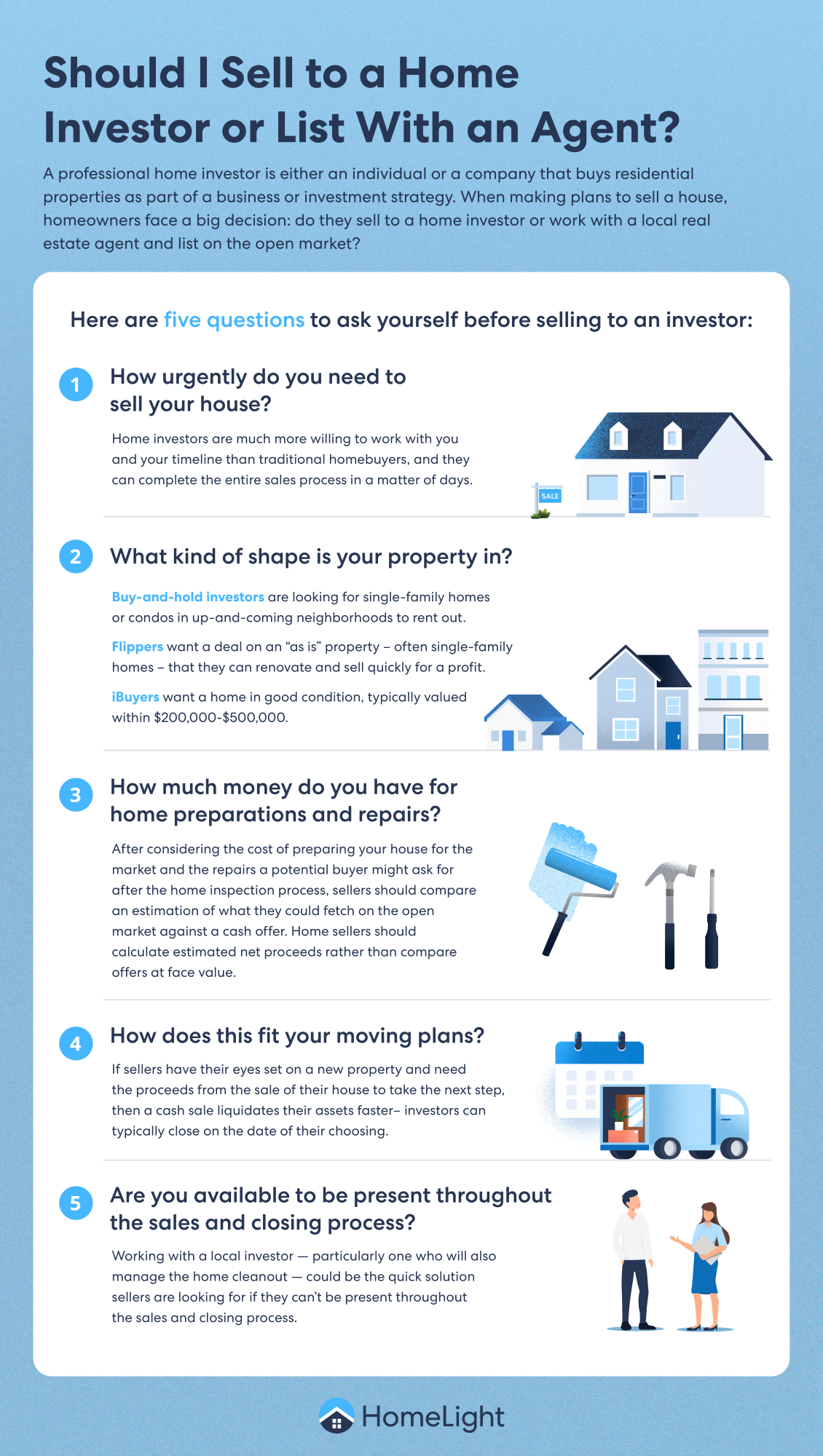
Five questions to ask yourself before selling to an investor
With an understanding of who home investors are, as well as the benefits and downsides of working with them, your next thought might be: Is this the right move for me? Let’s cover a few questions that can help you decide.
1. How urgently do you need to sell your house?
If you need to quickly settle an estate, divide marital assets in a divorce, or relocate swiftly for a new job, you can’t always wait for the standard 43-day or longer closing window. Home investors are much more flexible with sales timelines than traditional homebuyers and can complete the entire process in a matter of days.
2. What is the condition of your property?
Just as you consider what typical homebuyers want when preparing your home, it’s equally important to ask, “What do investors look for when buying a house?”
When deciding whether a homebuying company might be interested in your home, keep the following in mind:
- Buy-and-hold investors are looking for single-family homes or condos in up-and-coming neighborhoods to rent out.
- Flippers prefer deals on “as-is” properties, often single-family homes, that they can renovate and sell quickly for a profit.
- iBuyers want homes in good condition.
Depending on your market, multiple types of investors might be interested. Minteer says that “the majority of the properties that we see going in the direction of an investor sale are the ones that need more love.”


3. How much money do you have for home preparations and repairs?
Of course, you want to make money selling your home, but you also have to consider the cost of preparing the house for the market and the repairs a potential buyer might ask for after the home inspection process. The repair costs can be steep, typically 5% of the sale price.
As you compare an estimate of what you could fetch on the open market against a cash offer, you should calculate your net proceeds rather than compare offers at face value.
To help you sort out the math, HomeLight has a handy Net Proceeds Calculator where you can input your home’s worth and subtract the cost of agent commissions, home repairs, staging and preparation work, seller concessions, homeownership, and transfer taxes to get a ballpark idea of how much you’d actually pocket.
4. How does this fit your moving plans?
If you’ve already got your eyes on a new property and need the proceeds from the sale of your house to take the next step, then a cash sale liquidates your assets faster. Investors can typically close on the date of your choosing, even if it’s within a few days.
In some cases, they “can provide specialized solutions for each specific seller’s situation,” says Ryan Substad, real estate investor at Northwest Property Solutions. “For example, they can release the money to the seller early to help pay for moving expenses if cash is tight.”
5. Are you available to be present throughout the sales and closing process?
If you’ve inherited a property that is out of the area, the process of cleaning out the home, staging it for sale, and being present for the closing process might seem like more than you want to take on. In this case, working with a local investor, particularly one who will manage the home cleanout, could be the quick solution you’re looking for.
How to vet a real estate investor and spot a scam
When selling your home to an investor, it’s important to make sure you’re dealing with someone trustworthy. Here are five tips to help you separate legit investors from potential scams:
- Check their online presence: Legitimate investors typically have a professional website and active social media profiles. If you can’t find any online information or reviews, that’s a red flag.
- Look for reviews and testimonials: Search for reviews on Google, Yelp, or the Better Business Bureau (BBB) to see what past clients say. Be cautious if you find mostly negative feedback or no reviews at all.
- Ask for proof of recent purchases: A real investor can provide documentation or references from recent home sales. Scammers often avoid sharing verifiable records or delay giving you details.
- Avoid high-pressure tactics: If an investor pushes you to sign quickly or discourages you from consulting others, be wary. Trustworthy investors give you time to think and encourage you to ask questions.
- Verify licensing and registration: Check if the investor is registered with local real estate authorities or holds any relevant licenses. Lack of proper credentials can indicate a scam or unprofessional behavior.
If a simplified sale is the priority, selling to an investor might be right for you
Now that you understand the key differences between selling to a traditional homebuyer and a home investor, the next step is to evaluate which path is right for you. As we stated earlier, while working with an investor won’t necessarily result in the biggest financial gain, what it will bring you is a speedy and simplified selling process.
To ensure you’re getting the best value for your home and working with a reputable investor, you may want to enlist a top real estate agent in your area who can offer guidance throughout the process.
Looking to Sell Fast? A Top Agent Can Help
If you’re looking to sell fast, a top agent has the expertise in pricing, marketing, home prep, and negotiation to help make that happen, while helping clients earn more from their home sales than average agents.
Alternatively, you may find several primary residence buyers who can bring cash to the table. By working with them, you experience the quick sale you’re looking for through the traditional home sales process without dipping below the asking price.
Try HomeLight’s Home Value Estimator to get a ballpark estimate of your home’s current value. Or if you prefer a no-hassle transaction, request a no-obligation all-cash offer from HomeLight’s Simple Sale platform.
FAQs about selling to a home investor
Selling your house to an investor is usually quick and hassle-free. Investors often buy homes as-is for cash, allowing you to skip repairs and traditional financing delays. After evaluating your property, they’ll make an offer, typically below market value. If accepted, the closing process moves fast, sometimes within days, making it a convenient option.
Just as in a traditional home sale, you’re under no obligation until the contract is signed. It’s perfectly acceptable and encouraged to get multiple investor offers to compare your options and ensure you’re getting the most value from the sale of your home.
Institutional investors bought 6.6% of all U.S. homes sold in the first quarter of 2026. When you look at cities with enough data, the places where investors bought the biggest chunk of homes were Mobile, Alabama (15%), Memphis, Tennessee (14.8%), Boise City, Idaho (14.4%), Salisbury, Maryland (13.4%), and Huntsville, Alabama (12.4%).
The biggest mistake sellers often make is accepting the first investor offer they get without fully understanding their property’s value or checking the investor’s reputation. Jumping at the first offer can lead to missed opportunities or working with less trustworthy buyers.
That’s why it’s important to get multiple offers and thoroughly research each investor before signing anything. Reputable investors usually have a website, positive online reviews, and can provide proof of recent sales.
Yes, but like all things, not all home investors are created equal, and there are some bad apples in the mix. As previously mentioned, this is why it’s so important to get multiple quotes, do your research, and have a top real estate agent on your side who can help you evaluate offers and ensure you’re making the right decision for you and your financial future.
One thing to watch out for, in particular, is an investor who tries to put down less than 10%. A serious buyer will have the cash available to put down with the offer.
According to ZipRecruiter, the national average salary for real estate investors is $86,796 a year. Of course, this number is highly variable, as some investors consider real estate a part-time side income rather than a full-time job. Top earners can earn $119,000 or more annually.
It all boils down to your goals. A Realtor helps you sell your home at market value, guiding you through the process and ensuring you get the best price. An investor, on the other hand, may buy your home quickly, often at a lower price, offering a more streamlined, hassle-free sale.
Header Image Source: (Scott Graham / Unsplash)
At HomeLight, our vision is a world where every real estate transaction is simple, certain, and satisfying. Therefore, we promote strict editorial integrity in each of our posts.