

Process of Selling a House for Cash in 9 Steps
- Published on
- 11 min read
-
 Richard Haddad Executive EditorClose
Richard Haddad Executive Editor
Richard Haddad Executive EditorClose
Richard Haddad Executive EditorRichard Haddad is the executive editor of HomeLight.com. He works with an experienced content team that oversees the company’s blog featuring in-depth articles about the home buying and selling process, homeownership news, home care and design tips, and related real estate trends. Previously, he served as an editor and content producer for World Company, Gannett, and Western News & Info, where he also served as news director and director of internet operations.
If you need to sell your home quickly, finding a cash buyer for your house may be the solution you’re looking for. This approach can save you time and reduce the usual stress of listing and showings. In this post, we’ll show you the process of selling a house for cash.
In former days, the decision to sell your house for cash was primarily associated with a neglected or distressed property whose value had fallen, leaving homeowners with few options. But today, it’s a popular option for all kinds of sellers who just want a faster, easier sale, no matter what shape their home is in. Yet despite its growing appeal, the process of selling a house for cash is still often misunderstood.

Start with a No-obligation Cash Offer for Your Home
Tell us about your home and speak to a home consultant. We use your local neighborhood data and our extensive investor network to find the best offer for your home.
“A lot of sellers think selling a house ‘for cash’ means the buyer is going to show up with a briefcase full of money for them, but that’s not the case,” says Lucas Machado, a real estate investor and owner of House Heroes, LLC.
A “cash offer” simply means the buyer has cash readily available to pay for the home, and the offer is not dependent on being able to secure a mortgage. Still, if you’ve never sold a house for cash before, the process can feel just as confusing.
In this post, we walk you through the step-by-step process of selling a house for cash so you can make an informed decision about whether it’s right for you.


1. Check on the value of your home
Cash buyers offer sellers various conveniences, including a shorter closing, a guaranteed deal, and the option to sell “as is” and save money on repairs. However, cash offers tend to be lower than financed offers.
Cash buyers often pay less than market value to account for repair costs, with the final offer depending on market conditions and the state of your home.
Homeowners can request a free home value estimate online, thanks to the development of algorithmic automated valuation model (AVM) pricing tools. These online estimators gather data from a variety of sources, including county assessors, recorder’s offices, real estate listing websites, title companies, and user-generated questionnaires, to provide near-instant property value estimates.
While an online valuation won’t deliver the same level of accuracy as a professional appraisal or a real estate agent’s comparative market analysis (CMA), requesting one is quick and often completely free. HomeLight’s Home Value Estimator is a good place to start.
2. Find a cash buyer and request an offer
You know your home’s worth, and you’re ready to search for a qualified cash buyer. Below are some of the most common cash buyer options:
Types of cash home buyers
Franchisors: These are real estate investment companies that franchise their model under their company name in multiple locations, such as We Buy Ugly Houses or Express Home Buyers. They usually let homeowners sell their homes “as is” and typically offer about 50% to 70% of a home’s after-repair value (ARV) to account for the amount of work the house needs.
iBuyers: The typical iBuyer uses an AVM to generate a competitive offer closer to market value on a home that needs only minimal work. As a result, they tend to pay more than franchisors. Most charge a service fee of about 5% to 6% of the home’s sale price, similar to an agent’s commission. Some well-known iBuyer companies that provide all-cash offers include Opendoor, and Offerpad.
With HomeLight’s Simple Sale, you can simply fill out an easy questionnaire about your property and receive a no-obligation cash offer for your home within 24 hours. This online platform matches sellers with network buyers who use a variety of investment strategies and buy a wide array of properties, including homes that need little or a lot of work.
Simple Sale and HomeLight have a track record of satisfied customers.
With a cash-buyer platform such as HomeLight’s Simple Sale, you can skip the repairs and showings and sell your home in as little as 7 days.
House flippers: House flipping companies such as “We Buy Houses” purchase homes in need of repair, renovate them, and then sell them. They’re looking for a bargain, typically following the 70% rule, meaning they often offer no more than 70% of a property’s ARV. Estimated repair costs are typically subtracted from the 70%.
Buy-and-hold investors: This type of buyer purchases a home and then converts it into a rental property. They may sell the property once it has appreciated in value enough, as part of a long-term investment strategy.
Unlike flippers, buy-and-hold investors focus on a property’s rental income potential, not just its resale value. Because rental returns vary based on assumptions and long-term goals, their offers can be harder to predict or pin down to a clear range. Location and condition will play a big role in the offer you receive.
Trade-in companies: A trade-in company can help you buy and move into your new home before you sell your current home. Think of it as a swap that relieves you from paying two mortgages while waiting for your house to sell. Some examples of “buy before you sell” services include Knock and Orchard. These companies look for homes in good condition and tend to make cash offers closer to market value.
HomeLight has its own Buy Before You Sell program that makes the entire buying-and-selling process a whole lot smoother. HomeLight uses a special algorithm to figure out how much of your home’s equity you can tap into. That money can help cover your down payment, moving costs, closing fees, or even repairs on your new place.
With this set-up, you can make an offer on a new home without it being contingent on selling your current one. Once you’re settled into your new house, your agent will list your old place and get it sold so you can focus on moving, not juggling two homes. With Buy Before You Sell, you can dodge the headache of paying two home loans or having to move twice.
Learn in this video below how Buy Before You Sell works:

Consult with a top real estate agent
Maybe requesting a cash offer online right off the bat isn’t your style. You’d like an advisor to walk you through the process. No problem!
You can ask a knowledgeable real estate agent experienced in cash sales for a cash buyer recommendation. Many professionals are active in their local investor community and have an inside track to finding cash buyers.
Indar Lange, the owner of Honolulu-based Our Home Investments, Hawaii’s largest home-flipping company, says 60%-70% of his cash investments are the result of his relationships with agents. “We work with multiple agents who know we can buy for cash, including homes no one wants.”
3. Evaluate the price and terms of your offer
Evaluating a cash offer can be tricky. There’s no one-size-fits-all formula to calculate the strength of an offer. And there are other factors to weigh besides the amount of profit you’ll make.
Here are some key things to keep in mind when assessing an offer:
Your home’s condition: If your house is in great shape, Travis Steinemann, a real estate investor and founder of BuyHousesBR.com, says you can look at comparable properties that have sold recently in your area with a similar size and level of finish, and then subtract the agent’s commission and throw in whatever discount you feel the benefits are worth.
“Someone who is going through a foreclosure or who has a vacant house may value the speed and benefits of cash more than someone who just wants a bigger house,” Steinemann shares from his experience working with a variety of sellers.
If your house needs work, he suggests taking the approximate value of updated houses in your area and subtracting what it would cost to get your house in that condition. Then, deduct the commission and the investor’s profit (often around 15%), and you will arrive at a rough estimate of what could be a fair price.
Terms (it’s not just about the price): Price is one thing, but not all cash offers will offer sellers the same terms. Read the fine print to determine which steps the buyer is requesting to take before closing.
For example, some investors will purchase the home “as is” but still require an inspection. Others will offer to waive the inspection entirely, though it may mean accepting a reduced price to hedge the investor’s risk of finding major issues with the property.
While the use of all cash eliminates the need for a lender-ordered appraisal, some buyers may still request to have the house appraised before closing. The type of terms you can negotiate will depend on factors like the condition of your home and whether it’s a seller’s market. The fewer contract contingencies, the better for you as the seller.
Legitimacy of the offer: Before you move forward with the offer, you should review the following:
- Does the buyer plan on depositing an appropriate amount of earnest money?
- Does the buyer have a good track record of closing transactions?
- Is the buyer using a standard contract? If not, will you need an attorney to review the terms of the contract.
You should also request proof of funds to confirm that the buyer actually has the cash to complete the purchase. This verification can be a certified bank letter with the official letterhead and the signature of the authorized bank personnel.
To learn more, see our post: How Much Do House-Buying Companies Pay?
Pro tip: Top real estate agents recommend taking an extra step to confirm that the proof-of-funds letter hasn’t been forged. It’s wise to call the buyer’s bank to verify that the funds are available.
4. Compare your offer to an agent’s CMA
When you’re considering a cash offer, there is real value in reaching out to a trusted real estate agent to prepare a CMA of your home. This advanced pricing tool calculates the market value of your home by pulling in details about nearby properties of a similar size and style that have recently sold in your area. An agent uses these sale prices as a benchmark to set a home’s list price.
Alternatively, you could order your own home appraisal. “Although appraisals vary quite a bit and aren’t an absolute guarantee, it could help if you’re really struggling to pinpoint what would be a good price,” says Joanne McCoy, a top real estate agent in Lincoln, Nebraska.
“At the end of the day, if you’re going to get less than market value, you have to decide whether the benefits outweigh that loss.”


5. Happy with the offer? Sign the contract!
After accepting a cash offer, it’s time to sign the contract. This part of the process is very similar to what happens during a conventional home sale. You can choose to sign and accept the contract or have an attorney review the terms. The contract, which is usually prepared by the buyer, should include the following key details:
- Purchase price
- Deposit amount
- Any additional required fees
- Closing date
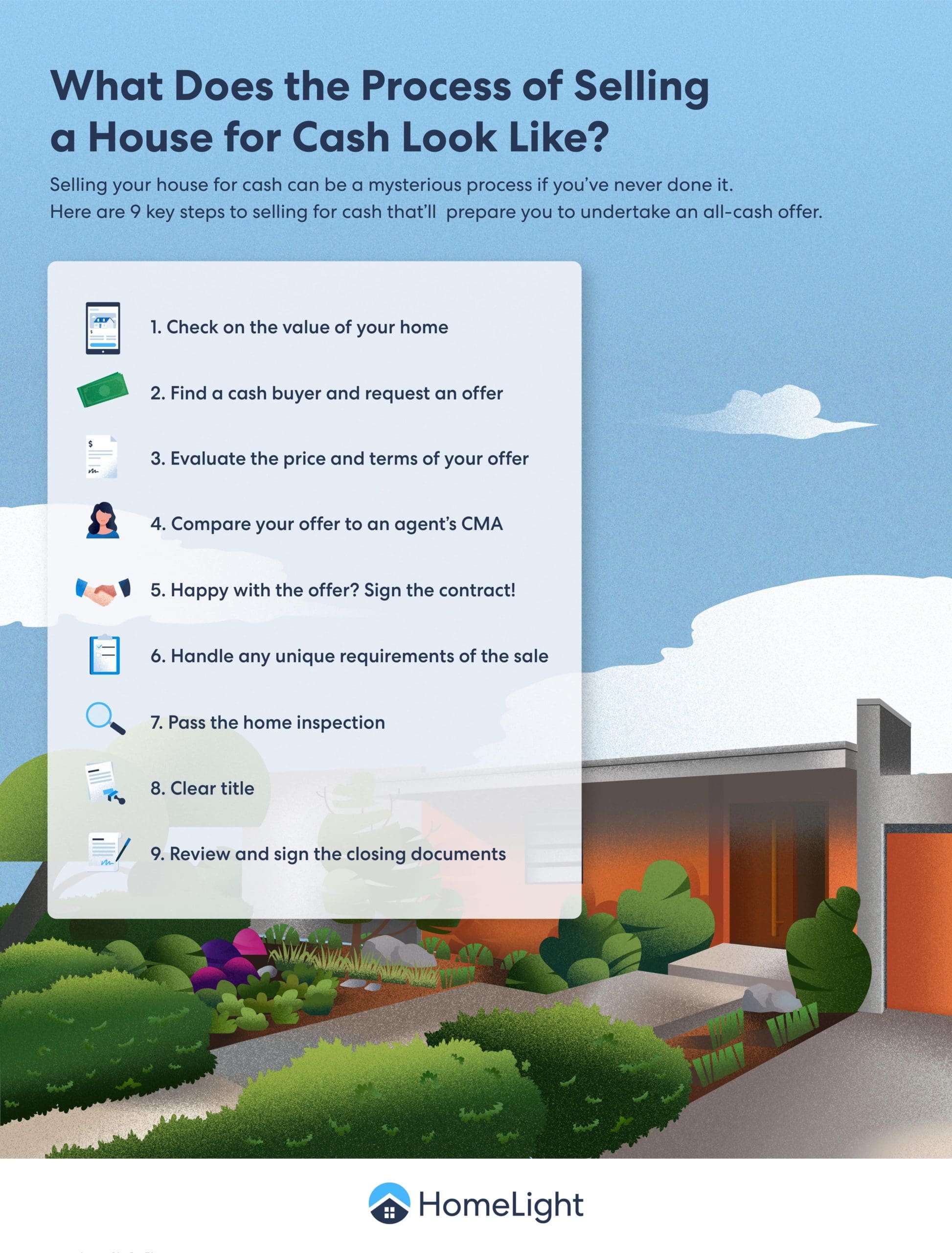
6. Handle any unique requirements of the sale
Depending on the buyer and local laws governing residential home sales, you may be required to complete some tasks to keep the sale process moving forward. For example, home sellers are usually obliged to disclose any known information about a property that could impact its value or the ability to live there safely.
Every state has its own rules about what’s legally necessary to disclose, and you can ask a real estate attorney or representative from the title company to provide you with the right documentation for your locale.
There may also be extenuating circumstances that can lengthen the cash sale process a bit. For example, if the house is in a homeowners’ association (HOA), the HOA may require 30 days to process the buyer’s application.
Another aspect of a real estate closing is the municipal lien search, a background check on your property to see if there are any legal claims against it. In some municipalities, it only takes a few days, but in others, it can take up to three or four weeks.
7. Pass the home inspection
Some cash buyers require a home inspection or on-site assessment. Others may purchase a home “sight unseen” or choose to waive the inspection.
“They would do this if they know their price is so good that anything wrong with the home is not an issue, or if they are planning on tearing down the home, and the land value is all that matters to them,” explains Steinemann. Those types of offers usually close very quickly, in about 7 to 10 days.
But buyers who opt for an inspection may renegotiate the final offer price to cover any required repairs, so it’s smart to anticipate and plan for more back-and-forth and a potential price reduction if an inspection is required for your sale.
8. Clear the title
Title problems can delay your closing, and a title search will be necessary to close the sale, regardless of whether your buyer is paying all cash or needs a mortgage. Unpaid taxes, a second mortgage, mechanic’s liens for past work done on the property, and outstanding alimony or child support are all common defects that can appear on your title and prevent the sale from moving forward until cleared.
You can avoid surprises by ordering a preliminary title report, handling disputes, and paying off liens ahead of time.
9. Review and sign the closing documents
The closing will likely be held at the office of a title company, escrow company, or real estate attorney, depending on the customs of your state. You’ll sign the same documents as you would in a traditional sale, such as the deed, settlement statement, and any property disclosures that haven’t already been completed. You can choose to have the title company draft the paperwork or let an attorney handle it.
Is cash king? When selling a house for cash, it’s your call!
Now that we’ve demystified the process of selling a house for cash, you can decide if speed and peace of mind outweigh the possible drawbacks.
As a home seller, one of the big things you want to do is eliminate as many question marks as possible and find a solution that fits your needs. If the questions involve a need for speed or simplicity, a cash offer can do both and more.
To see what a cash offer might look like for your home, check out HomeLight’s Simple Sale and secure an offer within 24 hours. If you’d rather work with a trusted expert, use HomeLight’s Agent Match tool to find a local agent who can guide you every step of the way.
To learn more, see our post: The Pros and Cons of Working With a We Buy Houses company.
Header Image Source: (Roger Starnes Sr / Unsplash)
At HomeLight, our vision is a world where every real estate transaction is simple, certain, and satisfying. Therefore, we promote strict editorial integrity in each of our posts.