

Selling Your House Off-Market: Is It Right for You?
- Published on
- 10 min read
-
 Stacy Sare Cohen, Contributing AuthorClose
Stacy Sare Cohen Contributing Author
Stacy Sare Cohen, Contributing AuthorClose
Stacy Sare Cohen Contributing AuthorStacy Sare Cohen is a seasoned content writer with a passion for real estate, home design, decor, and home improvement. She holds a B.A. in English from UCLA and has been published in Apartment Therapy, Angi, HomeAdvisor, and elsewhere. When Stacy’s not creating content, she’s dreaming up new project ideas for her newly remodeled condo.
-
Sam Dadofalza, Associate EditorClose
Sam Dadofalza Associate Editor
Sam Dadofalza is an associate editor at HomeLight, where she crafts insightful stories to guide homebuyers and sellers through the intricacies of real estate transactions. She has previously contributed to digital marketing firms and online business publications, honing her skills in creating engaging and informative content.
Thinking of selling your home but dreading the hassle of listings, showings, and negotiations? Some homeowners who want to skip all the hassle and still get a great deal often consider selling a house off-market. At a glance, it’s a low-stress way to sell, usually faster and with fewer headaches. But is it the right approach for your situation?

Connect with a Top Agent
Meet agents who go above and beyond.
Whether you’re selling your home off-market or going a more traditional route, working with a top agent can help your home sell more quickly and for more money.
In this article, you’ll learn about the benefits and drawbacks of selling a house off-market compared to a traditional sale, and why it isn’t the best option for every situation. Let’s take a closer look to see if selling your house off-market could be a good move that meets your needs.


Open market vs. off-market sale
There are two ways you can sell your home: publicly on the open market or privately as an off-market sale. Each option comes with its own pros and cons, so it really comes down to what works best for your situation. If you’re trying to sell quickly, avoid the hassle of showings, or keep the sale more private, one option may make more sense than the other. Let’s take a closer look at how each one works.
Selling your home on the open market
If you’ve sold a home through a Realtor, you likely remember your agent entering details about your property into the multiple listing service (MLS), a database that provides public access to the largest pool of properties for sale in the marketplace.
Your agent posted photos and information to market your property, including:
- Your asking price
- Your address
- Your listing agent
- Exterior and interior photos of your property
- Your home’s square footage
- Number of bedrooms and bathrooms
- Features and amenities
- Property taxes
- Number of days on the market
These and other details about your property then make their way onto every real estate website, where interested buyers get their first peek at your home.
Selling a house off-market
In contrast to the open market, the other option is to sell your house off-market. In an off-market sale, the seller doesn’t list their home on the MLS. Instead, they sell directly to a buyer.
This can be done without an agent, such as by requesting an all-cash offer from a house-buying company or by working with a real estate agent to share the listing with a private network of buyers as an office exclusive. This differs greatly from the conventional way of marketing a property publicly on the MLS, where it’s easily accessible to any broker, agent, or the general public.
Pocket listings explained
Prior to 2020, off-market listings, also called “pocket listings” or “quiet listings,” were a more regular practice among agents, though they could be somewhat controversial due to their lack of transparency.
As the name suggests, an off-market listing is a property that is for sale but not publicly advertised on the MLS or widely marketed online. Instead, the agent shares the home privately within their own network of buyers, other agents, or select clients.
The mindset was, “This is my listing. I’m not going to give anybody else access to it,” says real estate agent Jim Griffin, a top real estate agent in Johnson City, Tennessee.
Some agents preferred off-market listings to increase their chances of representing both the buyer and seller, allowing them to earn the full commission. Others liked the control and exclusivity it gave them, especially when working with high-profile clients or testing a price before going public.


Understanding the Clear Cooperation Policy
In response to concerns about the fairness of this practice, however, the National Association of Realtors® (NAR) implemented the MLS Clear Cooperation Policy in 2020, putting an end to these secretive pocket listings to ensure that all potential buyers have fair access to listing information.
Specifically, the Clear Cooperation Policy requires agents marketing properties to the public to post a listing on the MLS within one business day. The term “marketing” is considered anything from posting an ad online to putting a sign in a yard.
“If we begin to show a listing, it has to be on the market within one day,” says Kim Pratt, working with over 67% more single-family homes than the average agent in Arlington, Texas. “We have to let the sellers know as well because the sellers can’t go around and market their property a week or two ahead of time.”
According to Pratt, agents have the opportunity to market a property as “coming soon” under this policy, but are prohibited from showing it until it is posted on the MLS within the one-day period. She comments further that these rules deter listing agents and their partners from keeping listings away from other brokers and agents.
The end of pocket listings doesn’t mean the end of private listings
It may be the end of the pocket listing as we knew it, but agents can still market private listings as office exclusives. This allows agents to share the listing with other agents within their brokerage without putting it on the public MLS. The key is that the listing must stay within the brokerage and cannot be publicly marketed.
Pratt says she can market a property within the office that could be sold as a private listing to an investor or client within the brokerage, but it needs to stay in-house. “I couldn’t call my friend down the street with another brokerage and let her know [of the listing],” Pratt explains.
Finding qualified buyers for off-market sales
There are plenty of investors who are always looking for a good investment, so it’s possible to find investment companies and buyers when you know where to look. Here are some ways you can find buyers interested in off-market sales:
Maximize office exclusives
It’s not difficult for a well-connected agent like Pratt, who has a strong network of investors, to find buyers for an off-market sale.
“We have a ton of investment companies. People call us all day long to get on that investment list because they want to be on the list of investors that get notified when properties are off-market.”
Although Pratt can inform agents inside the brokerage about properties, she’s not allowed to “blast it out to a list of investors,” she explains. “We can let sellers know we have investors. At that point, we can reach out to investment companies.”
Search iBuyers
Instant buyers or iBuyers use technology and algorithms to buy real estate quickly. Some have been known to make a cash offer in as little as 24 hours. Working with iBuyer companies can take the hassle out of arranging showings, open houses, and staging homes for sale.


Consider selling to a house flipper
Flippers are real estate investors who purchase properties with the intention of renovating and reselling them for a profit. Some even turn their trade into popular television shows. These companies, however, often purchase houses from auctions and other off-market sources way below market value, which means flippers might not give the best offer.
Look for buy-and-hold investors
Buy-and-hold investors purchase real estate properties as a means to strengthen their portfolios. As the name suggests, these investors hold onto properties for an extended period. They build wealth by generating rental income and receiving tax incentives and benefits. It’s not uncommon for buy-and-hold investors to pull equity from one home to purchase another.
Get a cash offer with Simple Sale
HomeLight’s Simple Sale platform connects sellers with cash buyers, providing a convenient way to skip the conventional listing process. Sellers won’t need to pay Realtor fees, arrange showings, or worry about the hassles of repairs, inspections, and staging a home for sale. Best of all, sellers receive a competitive cash offer within 24 hours when using the platform.
Here’s how Simple Sale works:
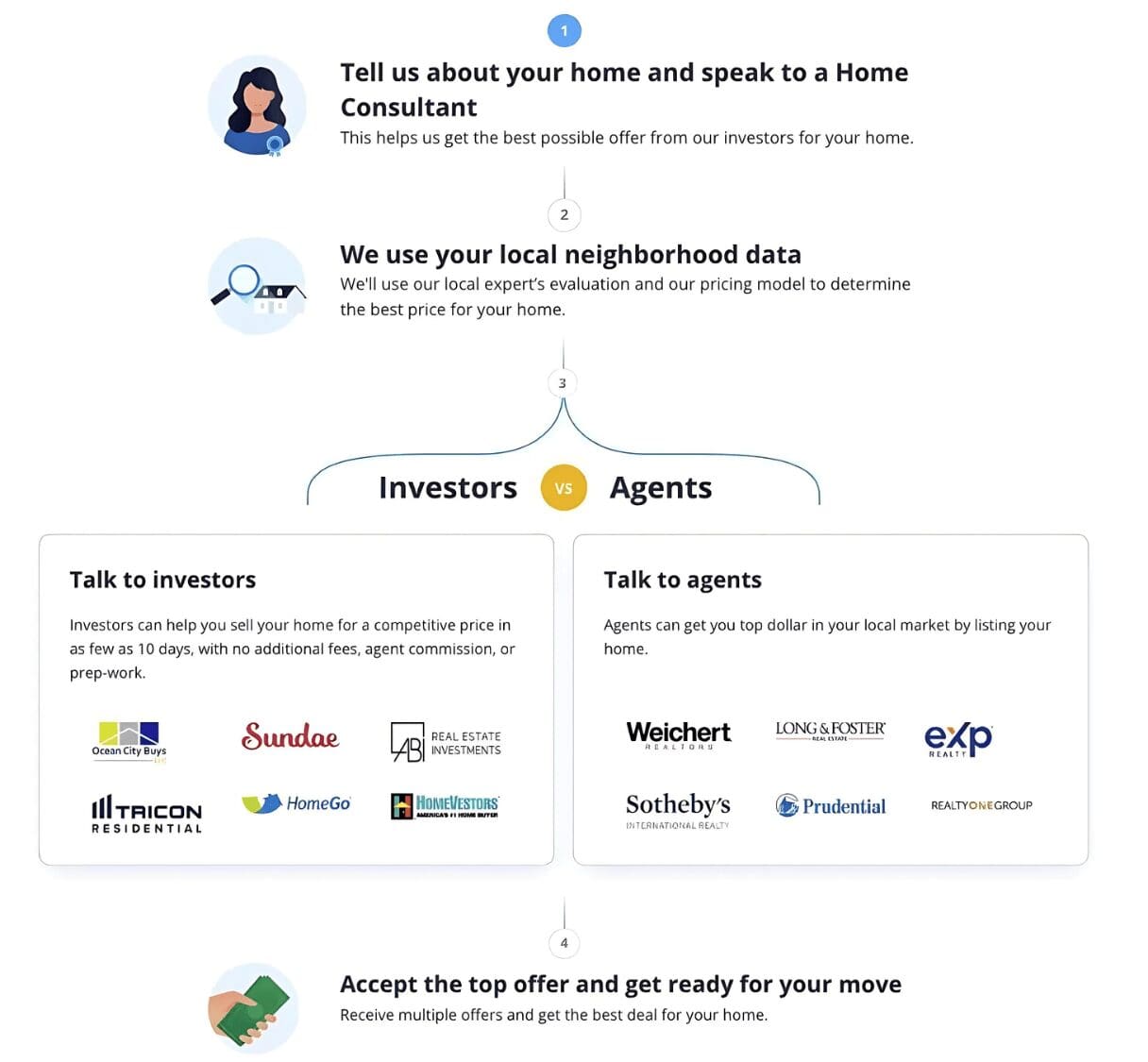
»Learn more: Want to know if a cash offer is really worth it? Use the Home Cash Offer Comparison Calculator to compare your options and see which offer puts the most money in your pocket.
Sell to friends and family
If you have a friend or family member interested in buying your home, you can sell it to them off-market. To save money, you might consider completing the sale without professionals, but know that selling to a family member can be tricky and still come with complications related to contracts, fees, and repairs.
Make sure to hire an attorney to handle the legal work. More importantly, keep in mind that if you set your price below fair market value, there could be tax implications. The IRS might see the discount as a “gift,” which could count toward your annual or lifetime gift tax exemption. For 2026, you can typically give up to $19,000 or $38,000 if you’re married and filing jointly, without needing to report it to the IRS.


Knowing your home’s current market value
Selling off-market changes the usual negotiation game because your property isn’t out there for everyone to see. Buyers might expect a discount since they’re taking on more risk, and without competition, it’s hard to know if the first offer is your best. Jumping on that first offer can mean leaving money on the table.
Since you don’t have as much competition between buyers, you’ll need to be a little more intentional about how you handle offers. A few simple strategies, like sharing the home with a handful of serious buyers, asking for proof of funds, and setting an offer deadline, can help. These steps let you keep things private while still getting the best possible deal.
Before putting any of these strategies into action, it’s also important to have a clear sense of your home’s worth. Using HomeLight’s Home Value Estimator tool and answering seven simple questions, you can learn the value of your home in just two minutes. Our home value estimator uses market trends, sales data, and your home’s last sales price to determine the value of your home.
Is selling a house off-market right for you?
When does an off-market sale make strategic sense? The best way to answer that is to weigh the pros and cons. An off-market sale is ideal when you want privacy, discretion, and confidentiality. It suits home sellers who wish to skip inspections and repairs that delay the closing during a traditional sale.
On the flip side, sellers won’t receive as much exposure for off-market listings. MLS listings can lead to a higher purchase price that comes from multiple offers in a hot market. However, a buyer might offer a higher sale price to keep a property off the market. Let’s examine if selling a house off-market fits your needs.
Pros of selling a home off-market
Selling your home off-market can come with unique advantages, depending on what you’re looking for. You get more privacy and may have a simpler, more convenient selling process without all the usual steps of a traditional listing. Here are some of the biggest benefits:
- Discreet pricing strategy: You don’t need to publicize your asking price or share how many days your property has been on the market. You wish to test the waters and adjust the price gradually.
- Privacy during sensitive life events: You value privacy and discretion for sensitive and personal reasons. For example, you’re going through a divorce, and you prefer to keep the sale confidential.
- VIP discretion: You’re a high-profile individual and want to maintain confidentiality.
- Tenant-friendly home sale: If you’re renting out your property, you can sell the home with tenants without disrupting their living situation.
- No repairs: Your property is in poor condition, and you prefer to bypass the repairs.
- No traditional sale hassles: You prefer to skip staging, open houses, and frequent, impromptu showings.
- Quick transaction: You need to sell your home fast because you have a deadline, or you’re about to go into pre-foreclosure or foreclosure. Going with an off-market sale can help get it sold before it’s taken by the bank, Pratt says.
Cons of selling a home off-market
If you want your home to get as much exposure as possible and don’t mind sharing the details publicly, selling on the open market may be the better choice. It’s especially worth considering if you’re comfortable listing your home on the MLS and your main goal is to sell for more money. Here are some situations where an off-market sale may not be the best fit:
- Flexible selling timeline: You’re not in a hurry to sell and are willing to take the time to stage your home and make repairs if it means getting a better offer.
- Limited price flexibility: You have a firm asking price and aren’t willing to accept a lower offer. With the limited number of buyers when listing off-market, “you might have to take a little less money than if you went on the open market,” Griffin says.
- Priority on top dollar offers: You want to get the highest price possible for your home. Listing your home off-market means it will have less of a chance of starting a bidding war.
If you have the opportunity to make $20, $30, $40 or $50,000 over asking, it doesn’t make sense to sell off-market. On the other hand, somebody may make an offer higher than the listing price to stop the property from going on the market.
 Kim Pratt Real Estate AgentCloseKim Pratt Real Estate Agent at NextHome On Main5.0Currently accepting new clients

- Years of Experience 17
- Transactions 587
- Average Price Point $250k
- Single Family Homes 560


Steps to a successful off-market sale
Selling a home off-market comes with its own set of challenges, from finding serious buyers without listing publicly to navigating legal requirements. It can feel tricky to balance privacy with a smooth, hassle-free sale. These steps explain what off-market sellers should do to handle the process confidently and avoid common pitfalls.
Explore various marketing methods
These targeted marketing methods can help you reach serious buyers without putting your home in front of the entire public.
- Agent-to-agent networking: Real estate agents often share off-market opportunities within their professional circles, especially in tight-knit local markets. This word-of-mouth strategy ensures listings are only shown to serious, qualified buyers.
- Exclusive buyer lists: Many agents and investors keep a list of buyers who are actively looking for homes that aren’t publicly listed yet.
- Targeted outreach to past buyers: Agents may reach out to past clients or investors they know who have bought similar properties before. It’s a simple way to use existing relationships to find interested buyers without publicly listing the home.
Provide required disclosures
Most U.S. states require sellers to provide a disclosure statement to buyers. You need to inform the buyer of any broken or damaged items, as well as potential hazards, such as lead-based paint, mold issues, or asbestos. Know that if you fail to be transparent about these issues, you can end up being sued in court.
Ensure your property has a clear title
For real estate to change hands from a seller to a buyer, the property needs a clear title. A title search must be performed by a title company or an attorney to make sure the seller is the legal owner and that they don’t have any liens from creditors or legal claims on the property.
If you have a lien on your property, you can work the payment into the settlement of the sale at closing. Reach out to an attorney to learn your options.
Close the deal
The day of the closing has finally arrived. You and the buyer will sign documents, pay closing costs, and address escrow items. You’ll transfer ownership of the property to the buyer and provide the keys. In return, you’ll receive a cashier’s check or a wire transfer of fees to your bank. The deal is done.
Avoid Listing Your Home Entirely
Skip staging and repeatedly showing your home by requesting a cash offer through HomeLight’s Simple Sale platform. We provide cash offers for homes in almost any condition nationwide, reducing the burden of making a house look perfect for possibly months on end. Receive an offer within a week and close in as little as 7 days.
Ready to sell a house off-market?
Selling your home off-market can be a great way to save time and avoid the stress of endless showings. But on the flip side, you might miss out on multiple offers that could drive up the price.
Before making a move, be sure you know your home’s true value, so you don’t leave money on the table. Connect with a top real estate agent to get a better idea of your home’s value and personalized advice on the best way to sell based on your situation.
Frequently asked questions (FAQs) about selling a house off-market
Yes, selling a house off-market is legal in most cases. It simply means you’re selling the property without publicly advertising it on the MLS, but you still need to follow the same legal requirements that apply to a home sale. If you’re using an agent, they can also explain any MLS rules that may affect how you market the property.
Off-market sales can work for all kinds of sellers, including homeowners who want more privacy or don’t want to deal with public showings. They can also be a good fit for sellers who already have a potential buyer in mind, such as an investor or someone in their network. Some sellers also choose this route when they want to test the waters before listing publicly.
They can, but not always. Because an off-market home gets less exposure and may have fewer competing buyers, you may have less leverage to push the price higher. On the other hand, you could save on some selling costs or find a buyer willing to pay a fair price to secure the property fast.
Start by getting a realistic idea of your home’s value and reaching out to buyers who are already looking for properties like yours. A real estate agent can tap into their network, while you can also contact investors or people you know who may be interested. Be upfront about your asking price, have your paperwork ready, and make it easy for a serious buyer to move forward.
Header Image Source: (Paula Morin / Unsplash)
At HomeLight, our vision is a world where every real estate transaction is simple, certain, and satisfying. Therefore, we promote strict editorial integrity in each of our posts.